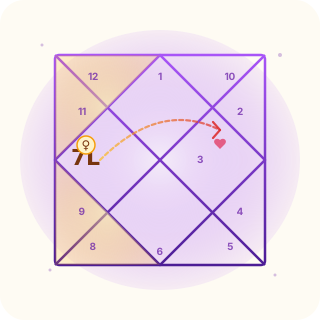
The 7th lord is different from planets IN the 7th house. The 7th lord is the planet that rules the sign falling in your 7th house — wherever that ruler sits across the twelve houses is where your marriage energy is directed. A 7th lord in the 1st house means marriage feels like an extension of self; in the 6th it brings conflict or a service-oriented spouse; in the 10th it produces the power-couple pattern; in the 12th it points to a foreign or spiritually-oriented partnership. This guide walks all twelve placements, the honest reading for each, and the common combinations that most heavily modify them.
What is the "7th lord" and why does it matter
Every house in your Kundli is ruled by the planet that owns the sign falling in that house. Whichever sign occupies your 7th house — Aries, Taurus, Gemini, and so on — the planet ruling that sign is your 7th lord: Mars, Venus, Mercury, and so on down the list. Aries and Scorpio are Mars; Taurus and Libra are Venus; Gemini and Virgo are Mercury; Cancer is Moon; Leo is Sun; Sagittarius and Pisces are Jupiter; Capricorn and Aquarius are Saturn. The 7th lord is the "director" of your marriage story — where they sit in the chart is where the marriage's energy, obligations, and expression get channelled.
This is one of the most important distinctions in classical Vedic reading. Two people can have the same planet in the 7th house (say, both have Saturn in the 7th) but have completely different 7th lords because their Ascendants differ — one has Sagittarius rising (7th lord is Mercury), the other has Aries rising (7th lord is Venus). Their marriage patterns will differ significantly because their 7th lords sit in different houses and carry different planetary natures. The planet IN the 7th shapes flavour; the 7th LORD shapes destination.
Classical tradition reads the marriage picture in a specific sequence: (1) planet(s) sitting IN the 7th house, (2) the 7th lord's placement — where it sits across the twelve houses, (3) the aspects the 7th lord receives, (4) the D-9 Navamsha 7th and 7th lord for internal texture, (5) the current Vimshottari Dasha to see which layer is presently activated. This guide covers step 2. For step 1, see our Planets in 7th House guide.
This one needs your chart: the 7th lord differs by Ascendant, so there is no general answer. Generate your free Kundli — it names your Ascendant and shows every house and its occupants, which is what you need to find the ruler and follow the twelve placements below.
7th lord in the 1st house
The 7th lord sitting in the 1st brings the spouse's energy into the self. The classical readings:
- Spouse feels like an extension of self. The partner and native share similar dispositions, interests, or life direction. Onlookers often describe them as "made for each other" or as reflecting each other's traits. The marriage forms a strong personal identity for the native.
- Strong personality match. The couple is often physically similar in build or aesthetic, and often shares values on major life questions. Conflict rates are lower than average because agreement is easier to reach.
- Marriage arrives on time or early. 7th lord in the 1st (a kendra) is a classical timing signature for on-schedule or early marriage — the karaka is well-placed to activate.
- Risk of over-fusion. The one caution: the "extension of self" quality can slide into loss of individual identity if not consciously balanced. Both partners benefit from maintaining independent friendships and interests.
7th lord in the 2nd house
The 2nd is the house of accumulated wealth, family lineage, and speech. The 7th lord here brings marriage into the family-wealth axis:
- Spouse brings wealth or comes from a wealthy family. Classical texts consistently name this placement as a signature for prosperity through marriage — either the partner comes with resources, or the marriage triggers a period of family wealth accumulation.
- Marriage strengthens family. The partnership tends to integrate closely with both families of origin; joint-family living or strong extended-family involvement is common.
- Family-arranged marriage pattern. The 2nd house is family; the 7th lord here classically indicates the marriage will be family-facilitated (either arranged or heavily family-supported), even if the choice starts as personal.
- Spouse's speech and food matter. The 2nd rules speech and food — both partners often find these dimensions unusually important in the marriage. Compatible eating patterns and communication styles carry more weight than usual.
7th lord in the 3rd house
The 3rd is the house of courage, siblings, effort, and short journeys. A 3rd-house 7th lord produces:
- Courageous, initiative-taking spouse. The partner tends to be a self-starter, physically or mentally active, entrepreneurial or professionally driven. Passivity is uncharacteristic.
- Siblings play a role in the marriage. Sometimes the partner is introduced through the native's siblings or a sibling network; sometimes the marriage creates strong sibling-like bonds between the two families.
- Frequent short travel together. The 3rd governs short journeys; couples with this placement tend to travel together often — weekend trips, business travel with partner, migration for careers.
- Effort required for marriage. The 3rd is Parakrama (personal effort). This placement often indicates that marriage requires the native's active effort — courtship is not passive, and the partnership continues to require active tending. This is not a negative — it is a signature of a marriage that stays alive because both partners keep showing up.
7th lord in the 4th house
The 4th is home, mother, land, vehicles, and emotional foundation. The 7th lord here settles marriage into the domestic core:
- Home-oriented spouse. The partner tends to be domestically-inclined, prioritises the home, is often skilled at homemaking regardless of gender, and finds fulfillment in the domestic sphere.
- Marriage brings domestic stability. The marriage often coincides with buying property, building a home, or settling in one place after a mobile earlier life.
- Spouse close to the native's mother. Classical texts name this as a signature for warm mother-in-law relations from the native's side; the spouse often builds a close bond with the native's mother.
- Emotional comfort as the primary marriage value. The marriage is read more for the emotional shelter it provides than for external ambition or public visibility.
7th lord in the 5th house
The 5th is romance, children, creativity, and past-life merit. The 7th lord here produces the love-marriage signature:
- Love marriage pattern. The 5th (romance) and 7th (marriage) lord exchange or placement is one of the classical primary signatures for love-marriage. The relationship starts as romantic attraction, then transitions to marriage — the arranged-marriage pattern is less characteristic. See our Love vs Arranged Marriage guide for the full pattern.
- Children through spouse — often early. The 5th is progeny; this placement tends to bring children into the marriage relatively early, often within the first few years, and the parenting bond becomes central to the marriage's emotional life.
- Creative or artistic spouse. The partner often has creative expression as a significant part of identity — art, music, writing, teaching, or building. The marriage supports creative work on both sides.
- Playfulness in the marriage. The 5th brings lightness and play; couples with this placement often maintain a playful, romantic dynamic long past the initial infatuation phase.
7th lord in the 6th house
The 6th is a dusthana — the house of conflict, service, illness, and enemies. The 7th lord in the 6th is one of the most cautioned placements in classical marriage reading:
- Conflict pattern in the partnership. The 6th is Ripu Bhava (enemy house); the 7th lord here classically indicates recurring disagreements, argumentative dynamics, or a partner who challenges more than accommodates. Not every fight — but a consistent friction signature.
- Service or health-worker spouse. The partner may be in medicine, nursing, social work, or a service profession; alternatively, the marriage carries a service-orientation where one partner regularly cares for the other's health or needs.
- Potential separation risk. Classical texts name 7th lord in 6th as one of the separation-risk signatures. This is not a divorce guarantee — many marriages with this placement endure — but the friction pattern requires conscious relational work.
- Spouse's health concerns. The 6th is illness; this placement can indicate periodic spouse-health issues that shape the marriage's daily rhythm.
- Softeners: If the 7th lord in the 6th is exalted, in own sign, or well-aspected by Jupiter, the friction reads much softer and can express as a marriage where both partners work through significant challenges together, ultimately strengthening the bond.
7th lord in the 7th house
The 7th lord in its own house (7th) — swakshetra — is the strongest possible placement for the 7th lord and one of the most classically-praised marriage signatures:
- Own house strength. A planet in its own house operates at full dignity. The 7th lord in the 7th means marriage functions as a central life anchor with full karmic support.
- Marriage is central to life. The partnership becomes the primary organising structure of the native's adult life. Career, home, children, social identity — all radiate outward from the marriage.
- Timing on-schedule. This is a classical on-time marriage signature — the karaka is well-placed to activate through its own Dasha or Antardasha.
- Stable, long-tenure partnership. Divorce rates for this placement are classically low. The marriage tends to endure across circumstances that would fracture other partnerships.
- Modifier caveat: If the 7th lord in the 7th is combust, retrograde, or heavily afflicted, the strength converts to intensity — the marriage is still central, but central in the sense of being all-consuming or dramatically difficult rather than serenely stable.
7th lord in the 8th house
The 8th is Randhra Bhava — the house of hidden things, transformation, in-laws (specifically the spouse's family), sudden events, and mortality. The 7th lord in the 8th is one of the most complex marriage placements:
- Hidden challenges in the marriage. The 8th governs what is beneath the surface. The 7th lord here classically indicates that the marriage carries dimensions that are not visible from the outside — hidden struggles, private complications, dynamics that only the couple knows.
- In-law involvement, sometimes friction. The 8th house classically rules the spouse's family; this placement often produces heavy in-law involvement, sometimes supportive (in-laws contribute resources or wisdom), sometimes friction-generating (in-laws overreach or interfere).
- Second-marriage possibility. Classical texts name 7th lord in 8th as one of the primary signatures increasing second-marriage probability. This is not verdict — many 7th-lord-in-8th first marriages endure fully — but the probability is measurably elevated. See our Second Marriage in Kundli guide.
- Transformation through marriage. The 8th is the house of profound change. This marriage often transforms the native's identity, worldview, or life trajectory in ways they could not have predicted at wedding.
- Longevity concerns for spouse — classical caution. Some classical texts flag this placement for spouse-longevity concerns. This is a tendency worth being aware of but never predicted deterministically; too many other factors dominate.
7th lord in the 9th house
The 9th is dharma, father, higher learning, long journeys, and foreign lands. The 7th lord in the 9th is one of the most benefic placements for the marriage:
- Dharmic spouse. The partner tends to be principled, values-driven, spiritually or ethically oriented, often working in teaching, law, medicine, dharmic institutions, or fields with a service dimension.
- Educated or highly-learned partner. The 9th is higher learning; the spouse often has strong academic credentials, or holds a position of intellectual respect in their community.
- Foreign or long-distance partner. The 9th governs long journeys and foreign lands. This placement often indicates a partner from a different city, region, or country — or a marriage that involves significant travel or eventual foreign settlement.
- Marriage brings good fortune. The 9th is Bhagya (fortune); marriage under this placement often marks the arrival of the native's most fortunate life phase — luck in career, resources, and opportunity increases after the wedding.
- Shared spiritual or philosophical path. The couple often shares religious or philosophical inclinations, and the marriage functions partly as a shared journey of meaning.
7th lord in the 10th house
The 10th is career, public status, authority, and reputation. The 7th lord in the 10th produces the power-couple signature:
- Career spouse. The partner is career-focused, professionally accomplished, often visible in their field. Ambition is a shared value; low-ambition partnerships are uncharacteristic.
- Power-couple pattern. The marriage functions as a mutual-support partnership for career advancement. Both partners often achieve more together than they would apart. Business partnerships between spouses are common with this placement.
- Public dimension of the marriage. The couple has visible social standing; the marriage is watched and known in the community, and reputation-management is part of what the couple does together.
- Marriage may coincide with career breakthrough. Timing-wise, the wedding often lands within a period when career also breakthrough — the two events reinforce each other.
- Less domestic focus. The trade-off: the couple may spend less time in the pure-domestic mode. Homemaking is often outsourced or shared; the primary shared activity is external-facing work.
7th lord in the 11th house
The 11th is Labha Bhava — the house of gains, income, networks, and elder siblings. The 7th lord here produces:
- Gains through marriage. The classical primary reading: marriage brings financial gain, whether through the spouse's earnings, the spouse's family, or partnership-enabled opportunities.
- Social or network-connected spouse. The partner is often well-networked, socially connected, or brings a large friend/professional circle into the native's life. The couple's social calendar is full.
- Late marriage possibility (mild). The 11th is the house of long-term goals; the 7th lord here can sometimes indicate marriage arriving later than average — the partnership forms as a long-term goal rather than an early-life default.
- Multiple offers pattern. This placement often produces a period where multiple partnership options present themselves; the choice is between good options, not the search for one.
- Elder sibling influence. The 11th also rules elder siblings; the marriage often has some connection to or influence from the native's or spouse's elder siblings.
7th lord in the 12th house
The 12th is Vyaya Bhava — expenditures, foreign lands, spirituality, seclusion, and loss. The 7th lord in the 12th is one of the most karmically loaded placements:
- Foreign spouse or foreign settlement. The classical primary reading: partner from a foreign country, or the marriage results in the native settling abroad, or long periods of the marriage lived in a foreign land.
- Spiritual partnership possibility. The 12th is Moksha (spiritual liberation); some 7th-lord-in-12th marriages take on a spiritual or ashram-like quality, where the partnership is oriented toward inner life more than worldly building.
- Separation or absence pattern. Classical texts flag this placement for physical separation from spouse — either through work-related travel, foreign postings, health-related absences, or in rarer cases through emotional distance in an intact marriage. This is a tendency worth naming honestly, not a certainty.
- Bedroom pleasures — classical mention. Interestingly, classical texts also note that the 12th is the house of "sayana sukha" (bed pleasures). The 7th lord here can indicate a marriage with strong physical-intimacy compatibility, even if the emotional or social dimensions of the marriage feel less settled.
- Expenditure on spouse or through marriage. The 12th governs expenditure; this placement often indicates significant financial outlays connected to the marriage — spouse's health, spouse's family, or lifestyle expansions the marriage introduces.
Softeners and modifiers — the placement is never read alone
Any of the twelve placements above can be significantly softened or intensified by the following factors, which classical tradition insists on layering onto every reading:
- Dignity of the 7th lord. If the 7th lord is in own sign, exalted, or in a friendly sign, all the placement's readings soften on the difficult end and strengthen on the benefic end. Debilitated, combust, or in enemy sign — the opposite.
- Aspect from Jupiter. Jupiter's aspect on the 7th lord (from anywhere) is the single most protective marriage signature in classical tradition. Even the most difficult placements soften substantially with Jupiter's aspect.
- Conjunction with malefics or benefics. The 7th lord conjunct Venus or Jupiter improves marriage substantially; conjunct Saturn, Rahu, or Ketu adds their respective flavours to the placement's reading.
- Nakshatra of the 7th lord. The nakshatra placement adds a further texture that a full classical reading always includes — see the individual nakshatra guides in our learn library.
- D-9 Navamsha confirmation. Where the 7th lord goes in the D-9 chart is often as decisive as where it sits in the D-1. When D-1 and D-9 agree on the placement's flavour, the signal is much stronger.
- Current Vimshottari Dasha. The 7th lord's Mahadasha or Antardasha activates whatever the natal placement indicates — the placement can sit dormant for decades until its Dasha fires. See our Vimshottari Dasha guide.
Reading the 7th lord's placement honestly
The 7th lord's placement tells you the direction your marriage energy is channelled — toward home (4th), career (10th), spiritual life (12th), family wealth (2nd), foreign lands (9th or 12th), or private transformation (8th). It does not tell you whether the marriage will be happy; that is a function of the whole chart. But knowing the direction is what lets you read the other signals in context. A 7th lord in the 6th tells you to be honest with yourself about conflict patterns; a 7th lord in the 5th tells you the marriage will always benefit from staying romantic even at 60; a 7th lord in the 10th tells you the couple is meant to build outward together.
To find your own 7th lord and its placement, generate your free Janma Kundli on Shubh Bhagya. It shows your Lagna and every house with the planets in it, so you can find the sign on your 7th house, look up its ruler, and see where that planet sits in the Planetary positions panel. The D-9 Navamsha chart and your current Vimshottari Dasha are on the same page. For a deeper look at what planets sitting IN the 7th house mean (a different but complementary reading), see our Planets in 7th House guide.