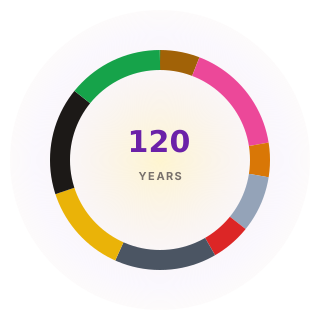
Vimshottari Dasha divides your life into 9 chapters totalling 120 years — each ruled by one planet. Which chapter you're in right now is the single most predictive piece of timing information in Vedic astrology. Knowing your current Mahadasha and Antardasha explains why a period feels the way it feels, and points at what's coming.
What is Vimshottari Dasha?
Vimshottari means "120" in Sanskrit — the total years the system covers. The 120 years are split unevenly across the nine grahas, each getting a fixed number of years called their Mahadasha (major period). The Mahadashas play out in a fixed sequence, starting from whichever planet ruled your birth Nakshatra.
Inside each Mahadasha, the 120 years further split into nine sub-periods called Antardashas — again in the same fixed sequence, and again proportional to each planet's total share. So there's always a "Mahadasha lord" (major period ruler) and an "Antardasha lord" (sub-period ruler) at any moment in your life. Their combined character shapes what you're going through.
Vimshottari isn't the only Dasha system in Vedic astrology — Ashtottari, Yogini, Kalachakra, and several Rasi-based systems exist. But Vimshottari is the most widely used because it produces the most consistent results for the majority of charts, and because Sage Parashara gave it prominence in BPHS.
The nine Mahadashas — durations and order
The fixed sequence, always in this order, always these durations:
- Ketu — 7 years
- Venus (Shukra) — 20 years
- Sun (Surya) — 6 years
- Moon (Chandra) — 10 years
- Mars (Mangal) — 7 years
- Rahu — 18 years
- Jupiter (Guru) — 16 years
- Saturn (Shani) — 19 years
- Mercury (Budha) — 17 years
Total: 120 years. Where you enter this sequence depends on your birth Nakshatra — which we'll unpack next. Once you know your entry point, the rest of your life plays out in that same order, cycling back to the start if you outlive 120 years (rare but not impossible).
How your starting point is determined
Every one of the 27 Nakshatras is ruled by one of these nine planets — in the same fixed sequence, cycling three times (9 × 3 = 27). At birth, wherever the Moon sits determines your first Mahadasha and how much of it is remaining.
Example: if you're born under Ashwini (ruled by Ketu), you start life in the middle of Ketu Mahadasha — with some balance of its 7 years remaining, depending on how far into Ashwini the Moon has travelled. When that balance ends, Venus Mahadasha begins for 20 years. Then Sun for 6. And so on.
If you're born under Bharani (ruled by Venus), you start in Venus Mahadasha — again with a balance depending on Moon's position within Bharani. This is called your balance of dasha at birth, and every serious Vedic reading calculates it precisely.
Generate your free Kundli on Shubh Bhagya — the Dasha panel shows your current Mahadasha and Antardasha with exact start and end dates, plus the sequence of the next several sub-periods. You don't have to calculate anything by hand.
Mahadasha vs Antardasha — the layered timing
Think of the Mahadasha as the backdrop — the mood and theme of a whole life chapter. Sun Mahadasha (6 years) makes career and identity central. Jupiter Mahadasha (16 years) makes learning, dharma, and expansion central. Saturn Mahadasha (19 years) makes discipline and structure central. Etc.
The Antardasha is the specific event driver inside that chapter. Even during a broadly favourable Mahadasha, a challenging Antardasha can bring specific difficulties. And vice versa — a challenging Mahadasha can still deliver surprising gifts during a favourable Antardasha.
Example: a person in Saturn Mahadasha (structural, disciplined) hitting the Saturn-Venus Antardasha might see marriage happen despite the Mahadasha's serious tone — because Venus is the marriage karaka and its sub-period activates that theme. Same person hitting the Saturn-Mars Antardasha might see conflict at work or a surgical procedure — Mars themes surfacing within Saturn's structural chapter.
How Antardashas are calculated
Each Antardasha's duration = (its planet's Mahadasha length × current Mahadasha length) / 120.
So within an 18-year Rahu Mahadasha, the Rahu-Jupiter Antardasha lasts (16 × 18) / 120 ≈ 2.4 years. The Rahu-Venus Antardasha lasts (20 × 18) / 120 = 3 years. And Rahu-Sun Antardasha, being shortest, is (6 × 18) / 120 ≈ 0.9 years.
The Antardasha sequence within any Mahadasha also follows the same fixed 9-planet order — starting from the Mahadasha lord itself. So Rahu Mahadasha begins with Rahu-Rahu (2.7 years), then Rahu-Jupiter, Rahu-Saturn, Rahu-Mercury, Rahu-Ketu, Rahu-Venus, Rahu-Sun, Rahu-Moon, Rahu-Mars. Same for every Mahadasha.
What each Mahadasha tends to bring
These are rough thematic patterns — real interpretation depends on how each planet sits in your chart, but the base themes are consistent:
Sun Mahadasha (6 years)
Identity, authority, career visibility, father, government dealings, health issues around the heart or eyes. Short but intense. See our Sun Mahadasha guide for the full picture.
Moon Mahadasha (10 years)
Emotional life, mother, home, public roles, mental peace or unrest. Often coincides with major life changes in domestic sphere. Waxing Moon in the chart gives smoother experience; waning or afflicted Moon can bring emotional turbulence.
Mars Mahadasha (7 years)
Energy, action, property matters, siblings, competition, surgery risk. Can be a period of aggressive career growth or of physical conflict — depends on where Mars sits natally.
Mercury Mahadasha (17 years)
Communication, business, education, networks. Often a period of substantial financial and intellectual growth. Mercury being flexible means the period bends easily to whatever the surrounding chart supports.
Jupiter Mahadasha (16 years)
Wisdom, expansion, children, wealth, teaching, dharma. Often the most broadly benevolent Mahadasha when Jupiter is well-placed. Marriage, first child, and major professional recognition frequently occur here.
Venus Mahadasha (20 years)
The longest and often most-loved Mahadasha. Marriage, romantic partnerships, comfort, luxury, art, business ventures related to beauty or vehicles. When Venus is well-placed, this is a long chapter of pleasure and material success.
Saturn Mahadasha (19 years)
Discipline, structural work, long-term achievement, testing. Slow but durable results when Saturn is well-placed. Health, job stress, or family responsibilities when Saturn is afflicted. Not "bad" — testing, in a way that ultimately builds.
Rahu Mahadasha (18 years)
Outward hunger, foreign lands, technology, ambition, unconventional paths, sudden rise or fall. Often the period where people leave home, change careers dramatically, or immerse in obsessive pursuits. Rahu delivers, but rarely in the way you expected.
Ketu Mahadasha (7 years)
Detachment, spirituality, sudden endings, loss of interest in worldly pursuits. Short but psychologically deep. Often follows a Rahu Mahadasha as its karmic counterweight — Rahu's chase gives way to Ketu's release.
Vimshottari Dasha shows the timing structure of a life. It doesn't guarantee specific outcomes. Two people in the same Mahadasha at the same age can have very different experiences because their natal placements differ. The Mahadasha creates the windows in which certain kinds of events become more likely; whether they actually happen depends on the whole chart plus choice.
What "activates" during a Dasha
The classical rule: during a planet's Mahadasha or Antardasha, the themes of that planet get amplified, and so do the affairs of the houses that planet rules and occupies. So a Jupiter Mahadasha in someone whose Jupiter rules the 5th and sits in the 10th tends to activate children (5th) and career (10th) simultaneously.
This gives Vimshottari its real predictive power. It's not just "you're in Jupiter Mahadasha, expect wisdom" — it's "your Jupiter rules the 2nd (wealth) and sits in the 7th (marriage), so this 16-year period is likely to bring wealth through marriage-related activities". Very specific. Very actionable.
Marriage, career, health — using Dasha to predict
Marriage timing
Marriage most commonly occurs during the Mahadasha or Antardasha of:
- Venus (universal marriage karaka)
- Jupiter (marriage karaka in a female's chart)
- The 7th house lord
- A planet occupying or aspecting the 7th house
- Sometimes the Navamsa (D-9) 7th lord too
When two or more of these fall in the same window, marriage becomes probable. When none do, marriage is unlikely no matter how much the seeker wants it.
Career changes
Watch the Mahadasha or Antardasha of the 10th house lord, the 10th house occupants, Sun (career visibility), Saturn (career discipline), and Mercury (business). A promotion or major career shift often coincides with one of these activating.
Health matters
Look at the Mahadasha/Antardasha of the 6th lord (illness), 8th lord (surgery, chronic), 12th lord (hospitalisation), and any malefic occupying or aspecting these houses. Not every such period brings illness — but preventive care lands better in these windows.
Astrology can indicate likelihoods — not certainties, not exact dates, not names. Anyone selling you "you will marry Mr. X on May 12, 2027" is overselling. What Vimshottari can genuinely tell you is: "your marriage window is more likely in this 2-year corridor", "career activation is due in the next Antardasha", "the current period favours consolidation, not new starts". Use it to inform decisions, not replace them.
How to actually use your Dasha timeline
- Generate your Kundli — see the current Mahadasha and Antardasha, plus the sequence for the next 20 years.
- Notice the tone shift at each Antardasha change. Even without deep analysis, you'll feel that Sun-Venus is qualitatively different from Sun-Saturn.
- Time your big decisions — matches with your current period's character. Marriage plans in a Venus/Jupiter period. Business launches when Mercury or Jupiter is active. Career risks when Sun or Mars is favourable.
- Prepare for hard periods — Sade Sati, Saturn Mahadasha, and Rahu-Maha's Ketu-Antardasha (~12 months, classically the most transformative sub-period) — with lifestyle discipline, community support, and appropriate spiritual practice. Preparation softens the transit.
- Don't fight your Dasha — the strategy that works in a Jupiter Mahadasha (expansion) fails in a Saturn Mahadasha (consolidation). Match your effort to what the period rewards.
Where to go next
- Read about the Rahu Mahadasha + Ketu Antardasha — the specific transition most Reddit posts ask about. Deeply illustrative of how Mahadasha+Antardasha layering works.
- Learn about Sun Mahadasha — the shortest and often the most-underestimated period.
- Understand Sade Sati — Saturn's 7.5-year transit, which sometimes overlaps with a Saturn Mahadasha and doubles the intensity.
Vimshottari Dasha is Vedic astrology's most beautiful contribution to human self-understanding — the recognition that life has chapters, and that each chapter has its own logic, its own rewards, its own tests. You are not the same person across all 120 years. Knowing which chapter you're in helps you write it well.