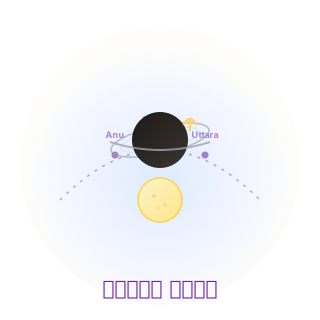
Sade Sati is the 7.5-year period when Saturn transits the rashi before your Janma Rashi (Moon sign), your Moon sign itself, and the rashi after. It's the most-feared transit in Vedic astrology and the most misunderstood. Done right, it's a structured course in maturity — not a punishment. Most lives are better, not worse, on the other side of it.
What is Sade Sati?
Sade Sati (साढ़े साती — literally "seven and a half") is the period when Saturn (Shani) transits across three consecutive rashis relative to your Moon sign: the 12th, the 1st (your Moon sign itself), and the 2nd.
Because Saturn takes about 29.5 years to circle the zodiac, it spends ~2.5 years in each rashi. Three rashis × 2.5 years = 7.5 years. That's where the name comes from.
Saturn moves slowly enough that most people experience Sade Sati only 2-3 times in their entire life — typically around ages 27-35 (first one), 56-64 (second), and 86-94 (third, if you live to see it). The first is often the most defining.
Phaladeepika (Mantreshwara) and Brihat Jataka (Varahamihira) both describe Saturn's 7.5-year transit across the Moon as a structured period of testing — not destruction, testing. Phaladeepika in particular notes the effects are heaviest when Saturn is in the Moon's sign itself (the middle 2.5 years), and that benefic placements plus genuine remedies significantly reduce difficulty. Sade Sati is not a sentence; it's a curriculum.
The three phases — what each 2.5-year window teaches
Phase 1: Arambha (Rising) — Saturn in 12th from Moon
Saturn enters the rashi before your Janma Rashi. Symbolically: the warning bell. What you've built starts feeling unstable. Sleep gets restless. Money flows out faster than expected. Old friends drift. You're being asked to let go of what won't survive the next five years.
The classical reading: Saturn is clearing space. Don't try to rebuild yet — just notice what's being subtracted.
Phase 2: Madhya (Peak) — Saturn in your Moon sign
The middle 2.5 years. Saturn now sits exactly on your Moon. This is the most intense phase: emotional fog, professional stagnation, health pressure, family dynamics shifting. The mind (which the Moon rules) is heavy.
But also: you're being shown who you really are stripped of comfort. The work done here is foundational. People often look back at the Madhya phase as the period that made them grow up.
Phase 3: Uttara (Setting) — Saturn in 2nd from Moon
Saturn enters the rashi after your Moon. Pressure on the second house: family, savings, voice, basic security. Money worries can resurface. Family responsibility increases.
By this phase you've been through the worst of it. The work now is integration — bringing the lessons of the previous five years into stable form. Many people start building genuinely durable things during the Uttara phase.
How to know if you're in Sade Sati
Two ways:
- Quick rule: find your Moon sign (Janma Rashi). Check where Saturn currently is. If Saturn is in your Moon sign, or one rashi before, or one rashi after — you're in Sade Sati.
- Precise check: use our free Sade Sati checker (or generate a full Kundli) — we flag the phase (Rising / Peak / Setting), show exact start and end dates, and the remaining time in your current phase. The tool is retrograde-aware: Saturn spends ~140 days per year in retrograde motion, and most simple calculators return start/end dates that are off by 6-12 months because they walk forward until Saturn first exits the Sade Sati window without accounting for retrograde re-entry.
Saturn is currently in Pisces (Meen) until early 2027, then moves to Aries. That means right now Sade Sati is active for people with Moon in Aquarius (Madhya phase), Pisces (Madhya), and Aries (Arambha — starting). Aquarius Moons are in the final Uttara phase as Saturn finishes transiting their 2nd house.
Related Saturn-from-Moon transits (not Sade Sati)
Two other Saturn transits are often confused with Sade Sati but are classically distinct ~2.5-year phases. Our Sade Sati checker now flags these separately so a user in one of these phases doesn't walk away thinking "I'm clear" when they're actually in a related challenging Saturn transit.
- Ashtama Shani — Saturn transiting the 8th house from natal Moon (~2.5 years). Themes: hidden struggles, health scrutiny, chronic-condition surfacing, unexpected turns, deep transformation, inheritance / legacy matters. Approach: prioritise health check-ups, avoid speculation, use the period for inner-work and closure rather than external launches.
- Kantaka Shani — literally "thorn Saturn"; Saturn transiting the 4th house from natal Moon (~2.5 years). Themes: home stability, mother's health, inner peace tested, property matters, possible relocation. Approach: stabilise home base, tend to mother's wellbeing, defer major home renovations if not already committed.
Neither Ashtama Shani nor Kantaka Shani is part of Sade Sati proper, but classical texts (BPHS §Shani, and knowledge base §2.5) group all three as Saturn-from-Moon transits worth naming in a chart reading.
What Sade Sati actually does (and what it doesn't)
Common effects classical texts mention:
- Career transitions — job loss, promotion stall, forced career change, or surprisingly, a slow promotion that requires real work
- Financial pressure — savings dip, unexpected expenses, slower income growth
- Family / domestic shifts — eldest family member's health, parental responsibility increases, sometimes loss
- Health concerns — Saturn-related (joints, bones, chronic conditions, sleep)
- Emotional weight — the Moon (mind) is what Saturn sits on; persistent mild depression or detachment is common
- Relationship rebalancing — partnerships that aren't real don't survive; partnerships that are real often deepen
Sade Sati does not guarantee disaster. It's a transit, not a curse. People with strong Saturn in their natal chart (Saturn in own sign, exalted, or in a kendra) often experience Sade Sati as a period of achievement — slow, hard-won, but real. Steel sharpens steel. A well-placed natal Saturn handles transiting Saturn with composure.
Why Saturn isn't actually the villain
Saturn rules: discipline, time, structure, karma, longevity, work ethic, the elderly, the marginalised, hard-won wisdom. The reason its transits feel painful is that most modern lives are built on the opposite — instant gratification, surface ambition, avoidance of difficulty.
When Saturn transits across your Moon, it isn't attacking you. It's saying: "You've built a life on what's not real. Let me show you." The people who fight Saturn during Sade Sati suffer more. The people who cooperate — work harder, drop pretence, take responsibility — often find the period unexpectedly grounding.
Classical remedies for Sade Sati
- Worship Vishnu daily — Vishnu (and Brahma) are Saturn's classical deities. A Vishnu mantra, or a Vishnu hymn of your own tradition, especially on Saturdays.
- Shani Stotra or "Om Shanaishcharaya Namah" — 108 repetitions on Saturday morning
- Light a lamp at a Shani temple on Saturday evenings
- Donate blankets, black sesame, iron, mustard oil, footwear to the elderly or poor — Saturn is honoured through service to those who have less
- Fast on Saturdays — one meal, no salt, no oil. Saturn responds to genuine simplicity, not theatre.
- Wear blue or black on Saturdays. Avoid red.
- Work harder, not less — Saturn rewards effort. The remedy isn't to escape difficulty; it's to meet it cleanly.
- Blue sapphire (Neelam) — the most powerful Saturn gem, but only after a careful chart consultation. Wrong-placement Saturn + Neelam can be destabilising. Never wear without verification.
What to actually do during Sade Sati
- Slow down major decisions. Saturn punishes haste. Big career moves, real estate, marriage — wait if you can, especially during the Madhya phase.
- Cut what's draining you. Saturn is going to subtract things anyway. Beat it to the punch: cancel the subscription, end the half-relationship, leave the job that's slowly killing you.
- Build one durable thing. Saturn rewards what's slow and real. Choose one focused project — health, skill, savings, relationship — and put 5+ years of patient work into it.
- Honour elders. Call your parents. Visit grandparents. Help neighbours who are old. Saturn rules age; treating elders well softens the transit.
- Don't shop your way out. Saturn doesn't care about retail therapy; it cares about discipline.
- Mark the end date. Sade Sati always ends. Knowing exactly when helps you keep perspective during the worst weeks.
Want to know which phase of Sade Sati you're in, and exactly when it ends? Generate your free Kundli — we mark the phase (Rising / Peak / Setting), the dates, and what to focus on in each. Also see the Dasha guide if Sade Sati overlaps with a Rahu or Ketu period — that combination has its own dynamics.
The actual teaching
Sade Sati is what real adulthood feels like compressed into 7.5 years. Most of life lets us pretend; Saturn doesn't. What you build during Sade Sati — the discipline, the friendships forged in difficulty, the work done despite the weight — these are the only things that survive into your 50s and 60s.
If you're in it now: you'll make it. Lots of people have. You'll come out the other side calmer, more honest, and capable of building things that last. The people who try hardest to skip this curriculum suffer most. The ones who lean into it often look back at Sade Sati as the period that made their life real.