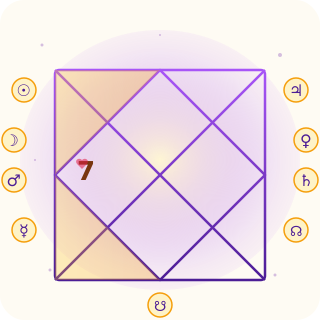
The 7th house is the mirror of your Ascendant — Vedic tradition reads the partner it attracts through whatever planet sits in it. Nine planets, nine distinct patterns: Sun attracts a dominant, authority-tinted spouse; Moon a nurturing, emotionally responsive one; Mars triggers the Manglik-dosha reading and an energetic, sometimes conflict-prone partner; Mercury a communicative, younger-looking spouse; Jupiter a wise dharmic partner (with the classical late-marriage flag for women); Venus the strongest marriage benefic — beauty, refinement, Malavya Yoga; Saturn delay, seriousness, an older or long-tenure partner; Rahu a foreign or unconventional spouse; Ketu detachment, spiritual partnership, sometimes a marriage that ends. None of these are verdicts — placements shape the flavour of the partnership, not the fact of one. This guide walks each planet in the 7th, then the per-Ascendant shifts you need to layer on before drawing conclusions.
Framing — the 7th house as the mirror of self
Classical Vedic tradition calls the 7th house Yuvati Bhava — the house of the young companion — and treats it as the mirror opposite of the 1st. Whatever you carry in the 1st (self, body, personality) tends to attract its complement or contrast in the 7th (partner, marriage, public dealings). The planet that sits IN the 7th is the loudest signal about what kind of partner your karma calls in, and the specific flavour that partnership takes on across a lifetime.
Two important framings before we go planet-by-planet. First, the 7th house is not only marriage — it is all one-on-one committed partnerships, including business partnerships and open public dealings. A planet in the 7th shapes all of these, not marriage alone. Second, no single planet is a verdict. A "difficult" 7th house planet (Saturn, Rahu, Mars) does not mean bad marriage; it means the marriage carries specific karmic themes that need to be understood and worked with. Some of the deepest, most enduring marriages in the classical texts belong to charts with Saturn or Rahu in the 7th.
The D-9 Navamsha chart is the primary reference chart for all marriage-specific questions in classical Vedic tradition. What sits in your D-1 (rasi) 7th house shows the visible pattern; what sits in the D-9 7th shows the internal experience of the marriage. Serious classical reading looks at both charts together. When they agree, the signal is strong. When they disagree, the D-9 usually describes the private lived reality of the partnership more accurately than the D-1.
The nine patterns below only matter once you know which one is yours. Generate your free Kundli — it lays out all twelve houses and what occupies them. If you already know, you can also run a Guna Milan against a prospective chart.
Sun in the 7th house
The Sun is the karaka of self, ego, authority, and government. When Sun sits in the 7th, several classical patterns activate:
- Dominant spouse pattern. The partner tends to carry visible authority — either a naturally dominant personality, a position of institutional power, a government or public-sector career, or a strong ego-presence. In a woman's chart this often reads as a "husband with a public role." In a man's chart it can indicate a strong-willed wife who does not defer.
- Ego friction in the partnership. The Sun in the house of "the other" classically produces some tension between self-assertion and partnership — one or both partners struggle to soften ego enough for full mutual accommodation. The friction is workable but consistently present.
- Reputation of the partnership matters. The public dimension of the marriage carries weight; the couple is often visible in their community, and reputation-management is part of what holds the marriage together.
- Health or vitality concerns for the spouse. Classical texts flag Sun in 7th for periodic spouse-health issues, especially eye-related or cardiac; this is a tendency, not a certainty, and is heavily modified by other placements.
The Sun in 7th is not a marriage-denial signature — it is a marriage-with-friction signature. Well-aspected (Jupiter aspect, benefics nearby), the friction becomes a productive dynamic; poorly aspected (Saturn conjunct, Rahu conjunct) the friction turns into recurring conflict.
Moon in the 7th house
The Moon is the karaka of mind, emotion, mother, and nurturing. Moon in the 7th produces one of the softer, more emotionally attuned 7th-house configurations:
- Emotionally responsive partner. The spouse tends to be caring, nurturing, sensitive to moods, often visibly maternal or paternal in bearing. The marriage feels like emotional safety more than intellectual sparring or physical passion.
- Mood-dependent partnership. The health of the marriage tracks the Moon's phases and transits closely — days when the transiting Moon is under stress often bring small emotional flare-ups; days when it is well-placed bring closeness. Learning to read this rhythm is one of the practical uses of astrology for a Moon-in-7th native.
- Waxing vs waning Moon distinction matters. A waxing Moon (paksha bala strong) in the 7th indicates a partnership that grows steadily; a waning Moon in the 7th indicates one that requires more conscious tending and can feel emotionally depleted if the couple is not intentional about it.
- Motherly or nurturing spouse. Beyond gender, the partner often "mothers" the native — cooks, remembers small preferences, provides emotional infrastructure that lets the native do the rest of their life.
Moon in the 7th is classically one of the most supportive marriage placements when the Moon is strong (waxing, unafflicted, well-aspected). When afflicted (waning + Saturn or Rahu nearby), the same placement can indicate emotional distance or a partner who carries their own mental-health load.
Mars in the 7th house
Mars in the 7th is the most-discussed 7th-house placement because it is the classical primary signature of Manglik Dosha. Read what our dedicated Manglik Dosha guide covers about cancellation rules and matching — most of this section assumes you already know the basics.
- Energetic, forceful partner. Mars adds physical energy, competitive drive, and often a short temper. The partner may be athletic, in the military or police, in a physically demanding profession, or simply high-energy in disposition. Chemistry is often intense; conflict is often loud rather than avoided.
- Manglik-dosha friction pattern. Mars in the 7th is one of the six Manglik-triggering houses. The classical concern is early-marriage friction, health stress on the spouse, or delayed marriage until the dosha resolves through age (many texts consider Manglik effects to soften significantly after age 28). This is the placement where matching two similar charts (Manglik with Manglik) is classically most helpful.
- Second marriage possibility increases. Untreated Manglik-dosha 7th-house Mars, especially when combined with Rahu or Saturn nearby, is classically flagged as a second-marriage risk. This is not a verdict; it is a probability to be worked with through matching, remedies, and emotional maturity.
- Cancellation matters more than the dosha itself. A Mars-in-7th chart with cancellations (Cancer/Leo Ascendant Yogakaraka rule, Mars in own sign, Jupiter aspect, matching with a similar chart) often produces perfectly stable, passionate marriages. The label without the cancellation check is over-diagnosed.
Mercury in the 7th house
Mercury is the karaka of intellect, communication, commerce, and youthful energy. Mercury in the 7th is a distinctly modern-favourable placement:
- Communicative, verbally alive partner. The spouse tends to be a talker — witty, well-read, socially quick, often working in communication-heavy fields (media, teaching, writing, technology, sales). Conversation is the primary bond of the marriage.
- Younger-looking or age-gap spouse. Mercury is Kumara (the eternal youth); the partner often looks younger than their years, has youthful energy, or is literally younger by some years. Classical texts flag Mercury in 7th as a common signature for a spouse three to seven years younger.
- Business-partnership orientation. The couple often either works together in business or the partnership carries a strong commercial/practical dimension. Financial decisions are made together and often profitably.
- Duality risk if Mercury is afflicted. Mercury is a mutable planet — well-placed it produces intellectual richness; afflicted (with Rahu or malefics) it can indicate scattered attention, communication misunderstandings, or partner who struggles with commitment.
Mercury in the 7th is generally one of the more contemporary-friendly placements — well suited to dual-career urban marriages where communication and shared work are the connective tissue.
Jupiter in the 7th house
Jupiter is the karaka of wisdom, dharma, teachers, and — for a female chart — the husband himself. Jupiter in the 7th is generally the most benefic single-planet placement in the 7th house, with one classical caveat:
- Wise, dharmic, teacher-figure spouse. The partner tends to be knowledgeable, older-seeming in wisdom (not always in age), often working in teaching, advisory, medicine, law, or spiritual domains. The marriage carries a sense of shared purpose beyond the personal.
- Blessings and stability. Jupiter's aspect on the 1st house (from the 7th, a natural aspect) is a classical protective signature — brings blessings on the self through the partnership. Marriage often marks the beginning of the native's most stable, prosperous life phase.
- The classical late-marriage flag for women. Here is the caveat: for a female chart, Jupiter in the 7th is classically listed as a late-marriage indicator. The reason given in classical texts is that Jupiter — being the karaka of the husband — sitting in his own house of "spouse" creates an over-abundance that delays the actual marriage until Jupiter's Dasha or a Jupiter-related trigger fires. Modern experience is mixed: many Jupiter-in-7th women marry on time; late-marriage tendency is more common with Jupiter retrograde or debilitated. Do not treat this as verdict; treat as "watch the Dasha timing carefully."
- Wealth and children through marriage. Jupiter also carries progeny significance; Jupiter in 7th classically indicates children arriving through the partnership as a natural expected outcome, along with financial prosperity that co-arrives with the marriage.
Venus in the 7th house
Venus is the karaka of marriage itself for a male chart, and the karaka of love, luxury, art, and refinement for all. Venus in her own house — the 7th, which she naturally rules through Libra — is classically an exceptional placement, sometimes forming the Malavya Yoga (one of the five Panch Mahapurusha Yogas):
- Beautiful, refined, aesthetically-inclined spouse. The partner tends to be physically attractive, well-dressed, artistically sensitive, often working in beauty-related, artistic, luxury, or hospitality fields. The marriage is one where visual and sensory pleasure matter and are honoured.
- Malavya Yoga possibility. If Venus is in her own signs (Taurus or Libra) in the 7th, Malavya Yoga forms — one of the strongest marriage-related yogas in the classical texts. The native gains lifelong prosperity, married happiness, comfort, and refined tastes. See our Venus guide for the full detail on Malavya Yoga's expression.
- Multiple partnership offers. Venus in 7th classically indicates a person who does not lack for interested partners — offers come, admiration is easy. The challenge is choosing well rather than finding at all.
- Luxury and comfort in marriage. The marriage typically involves a comfortable, sometimes materially-rich household — Venus does not tolerate austerity in her own house. If Venus is afflicted (combust, in Virgo — her debilitation, or with malefics), the same placement produces the opposite: partnership friction over money, spouse's spending, or comfort-seeking beyond means.
Venus in 7th is the placement that most consistently indicates marital happiness across classical texts — with the sole caveat that Venus in Virgo (debilitated) or combust turns the reading in the opposite direction.
Saturn in the 7th house
Saturn is the karaka of discipline, delay, service, and long-duration commitment. Saturn in the 7th is one of the most misread placements — the classical texts are more balanced about it than modern astrologers often are:
- Delayed marriage — the classical primary reading. Saturn in the 7th very commonly delays first marriage until the late 20s or 30s. This is not a curse; Saturn is a slow, deliberate planet, and marriages under his influence often benefit from the maturity that late arrival brings. See our Delayed Marriage guide for the specific patterns.
- Older or more serious partner. The spouse is often older than the native (three to ten years is common), or younger in years but carrying a Saturnine seriousness — reliable, structured, professionally established, not given to whimsy.
- Long-tenure marriage. Saturn is the planet of duration. Saturn-in-7th marriages, when they do form, are classically the most likely to last for life. Divorce rates are lower than the average; the marriage carries a sense of accepted commitment that outlasts flarelamps of passion.
- Emotional distance to watch for. The Saturnine coolness can produce emotional distance in the marriage — the partnership is steady but not always warm. Native and spouse both benefit from consciously cultivating warmth; the placement itself does not generate it easily.
- Saturn in own signs (Capricorn or Aquarius) is transformative. Saturn in his own signs in the 7th removes most of the difficulty and produces one of the most stable, dignified marriage signatures — often to a professionally accomplished, socially respected partner.
Rahu in the 7th house
Rahu is the karaka of foreignness, unconventionality, obsession, and sudden change. Rahu in the 7th is one of the most talked-about 7th-house placements in modern India because it correlates so strongly with the shifts in marriage patterns of the last generation:
- Foreign or unconventional spouse. The partner often comes from outside the native's community, region, caste, country, or religion. In earlier generations this was rarer and more disruptive; in modern India this is one of the most common Rahu-in-7th expressions — inter-caste marriage, foreign spouse, spouse from a very different cultural background.
- Sudden, unexpected marriage. Rahu produces suddenness. The marriage often arrives quickly, sometimes with short courtship, sometimes as a surprise even to the native. Long, careful, family-arranged deliberations are less characteristic; impulse or fated-meeting narrative more so.
- Fascination-based attraction. Rahu operates through fascination and desire. The initial attraction is often magnetic, almost obsessive, and the partner may embody something the native is deeply drawn to but does not fully understand. Reality tends to catch up over the first several years of marriage.
- Instability risk. Untreated Rahu in the 7th, especially with malefic aspects, is a classical instability signature — the marriage carries hidden complications, potential separation, or a partner whose actual nature turns out different from what was initially perceived. This is the placement most commonly cited in cases where a marriage that looked ideal at first turns unstable later.
- Second marriage possibility. Rahu in 7th, particularly combined with Saturn or with the 7th lord in a dusthana, is classically flagged as a signature that increases second-marriage probability. See our Second Marriage in Kundli guide for the full pattern.
Ketu in the 7th house
Ketu is the karaka of detachment, spirituality, past-life karma, and endings. Ketu in the 7th is the subtlest and most misunderstood 7th-house placement:
- Detached or spiritually-oriented spouse. The partner often carries a quality of inward focus, spirituality, non-attachment to worldly ambition, or a healing/service orientation. The marriage may feel deep but quiet, more contemplative than social.
- Past-life connection narrative. Classical texts strongly associate Ketu with past-life karma completing itself. Ketu in the 7th often carries a "we've known each other forever" quality on meeting, followed by a marriage that feels karmically inevitable rather than actively chosen.
- Emotional distance and disinterest to watch for. Ketu's detachment can express as the spouse being emotionally absent, disinterested in worldly ambitions the native holds, or physically undemonstrative. This is the placement where communication about needs matters most — Ketu-partners often do not intuit needs and require them to be named.
- Marriage that ends or transforms. Untreated Ketu in the 7th is classically flagged as a signature for marriages that end — either through separation, spouse's early departure, or a mid-life transformation of the relationship into something more spiritual or platonic. This is the most sombre 7th-house placement and requires the greatest care in reading; it is often over-interpreted and over-feared.
- Spiritual partnership possibility. When both partners are on a conscious spiritual path, Ketu in the 7th can produce an unusually deep, spiritually-collaborative marriage — the partners function as fellow-travellers on an inner journey more than as social units.
Real charts often have two or more planets in the 7th (conjunction). When this happens, blend the readings: Sun + Venus in 7th produces the beautiful-and-dominant partner (Sun's authority + Venus's aesthetics); Saturn + Rahu in 7th compounds delay AND unconventional partner AND separation risk (the most difficult 7th-house combination classically). No single-planet reading applies in isolation to a conjunction. Prioritise the lord of the conjunction sign, then the dominant planet by dignity, then the modifier planets.
Per-Ascendant shifts — how the same planet reads differently
Every 7th-house reading above assumes the planet's natural character. But the same planet in the 7th reads differently depending on which Ascendant makes it a functional benefic vs. malefic for your specific chart. A few of the most consequential shifts:
- Cancer Ascendant, Saturn in 7th (Capricorn): Saturn is in his own sign and is not a functional malefic for Cancer — this reads as a much more stable, dignified marriage than the general "Saturn in 7th delay" reading suggests. The spouse is often professionally established, older, and reliable in the best sense.
- Leo Ascendant, Saturn in 7th (Aquarius): Saturn in his own sign again, and Saturn is not a functional malefic for Leo — same beneficial shift. Delay is real, but the marriage itself is unusually stable.
- Aries or Scorpio Ascendant, Mars in 7th: Mars is in a friendly sign of his own dispositor's mirror; Manglik-dosha reading is significantly softened. See the Manglik Dosha guide for the full cancellation logic.
- Taurus or Libra Ascendant, Venus in 7th: Venus is in his own sign in his own house — the most powerful Malavya Yoga configuration, producing exceptional marriage prosperity.
- Gemini or Virgo Ascendant, Jupiter in 7th (Sagittarius or Pisces): Jupiter is in his own sign in the 7th — this is one of the most classically-praised marriage placements, producing wise, prosperous, dharmic partnerships. The late-marriage caveat for women is significantly softened by the own-sign dignity.
- Capricorn or Aquarius Ascendant, Sun in 7th: Sun becomes a functional malefic for these Ascendants — the "dominant partner" reading tends toward the more problematic end (ego friction, spouse-health concerns) more than the productive end. Extra attention to relationship dynamics is warranted.
Reading the 7th house honestly
The 7th house planet tells you one thing well: the flavour of partnership your karma calls in. It does not tell you whether the marriage will be happy, whether it will last, or when it will happen. Those are functions of the whole chart — 7th lord's placement, Venus/Jupiter conditions, Vimshottari Dasha timing, D-9 Navamsha structure, and the person's own conscious work on the relationship. A "difficult" planet in the 7th does not doom the marriage; it names the karmic curriculum the marriage will teach.
To read your own 7th house — the planet(s) placed there, and the 7th lord's placement (which often matters more than what sits in the 7th) — generate your free Janma Kundli on Shubh Bhagya. The chart shows your Lagna and which planets sit in each of the twelve houses, the Planetary positions panel lists every planet's house, and the D-9 Navamsha chart and your current Vimshottari Dasha are on the same page. To find your 7th lord, take the sign on your 7th house and look up its ruler. For the 7th LORD's placement across different houses (which we intentionally kept out of this guide to keep it focused on planets IN the 7th), see our companion 7th Lord Placement guide.