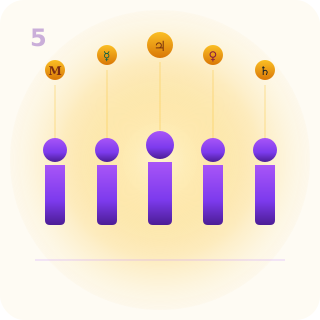
Panch Mahapurush Yoga (पञ्च महापुरुष योग) — "the five great person combinations" — is a group of five distinct classical yogas, one for each of the five tarah grahas (star planets: Mars, Mercury, Jupiter, Venus, Saturn). Each yoga forms when its planet sits in a quadrant (1st, 4th, 7th, or 10th house from Lagna) AND in its own sign or exaltation sign. The result: one is born as a mahapurusha — a "great person" — whose personality is dominated by that planet's elemental nature.
What "Panch Mahapurush" means
The name breaks down in Sanskrit:
- pañcha (पञ्च) — "five"
- mahā (महा) — "great"
- puruṣa (पुरुष) — "person" or "man" (but used gender-neutrally in classical texts)
Together: "the five great persons." Classical Vedic astrology holds that certain planetary yogas produce individuals of extraordinary quality — not necessarily wealthy or famous by ordinary standards, but distinctly greater in the specific domain their ruling planet governs. Each of the five yogas produces a different type of greatness.
Only the tarah grahas (star planets) qualify — Mars, Mercury, Jupiter, Venus, Saturn. The Sun and Moon are the two luminaries (not tarah grahas). Rahu and Ketu are shadow planets (chaayaa grahas). Neither the luminaries nor the shadow planets form Panch Mahapurush Yogas because the yoga rule specifically requires "own sign or exaltation" — and Sun/Moon each own only one sign, while Rahu/Ketu don't traditionally own signs at all.
The universal rule for all five yogas
Every Panch Mahapurush Yoga has the same structural requirement, applied to a different planet:
The planet must be in a kendra (1st, 4th, 7th, or 10th house) from the Lagna (Ascendant), AND that kendra must be a sign in which the planet is swakshetra (own sign) or uchcha (exalted).
Two important caveats from classical Vedic tradition:
- This yoga applies from Lagna, not from Moon. Unlike some other yogas (Gajakesari, for instance) which can be counted from either Lagna or Moon, Panch Mahapurush is specifically Lagna-based.
- This yoga applies mainly in the rasi (D-1) chart. Some astrologers extend it to Navamsha (D-9), but the classical primary application is the birth chart.
The five yogas in detail
Each yoga is named after its planet, and each produces a "great person of a specific tattva (elemental nature)".
1. Ruchaka Yoga (Mars — fiery nature)
Rule: Mars in Aries, Scorpio, or Capricorn, sitting in the 1st, 4th, 7th, or 10th house.
Ruchaka means "bright" or "shining". Native is a great person of fiery nature. Classical description: "He is a natural leader. He loves to fight wars and he is victorious over enemies. He is discriminative and a devotee of learned people. He is well-versed in occult sciences. He has good taste. He is always successful."
Modern reading: Ruchaka gives someone with visible martial strength — physical, mental, or organisational courage. Military leaders, entrepreneurs who thrive in competitive markets, athletes at the top of their sport, surgeons who handle emergencies, and researchers into occult/hidden fields often show Ruchaka Yoga.
2. Bhadra Yoga (Mercury — earthy nature)
Rule: Mercury in Gemini or Virgo, sitting in the 1st, 4th, 7th, or 10th house.
Bhadra means "auspicious" or "gentle". Native is a great person of earthy nature. Classical description: "He is lion-like. He is learned in all respects. He has a good build of body and a deep voice. He has sattwa guna. He knows yoga well. He is always surrounded by relatives, friends and family and enjoys his wealth with them. He maintains cleanliness in everything and he is very systematic. He has a spirit of independence. He is religious."
Modern reading: Bhadra gives someone with intellectual mastery combined with systematic character. Scholars, professors, published writers, business analysts, and successful practitioners of any craft that requires precision + intellect often show Bhadra Yoga. The "surrounded by family enjoying wealth with them" note is real — Bhadra natives are typically excellent at sustaining strong family/community networks.
3. Hamsa Yoga (Jupiter — ethery nature)
Rule: Jupiter in Sagittarius, Pisces, or Cancer, sitting in the 1st, 4th, 7th, or 10th house.
Hamsa means "swan" — the classical Vedic symbol of the pure soul that can separate milk from water (wisdom from confusion). Native is a great person of ethery nature. Classical description: "He is swan-like. He has spiritual strength and purity. He is respected by everyone. He is very passionate. He becomes a king. He has all comforts. He enjoys life fully. He is a clever conversationalist and endowed with good speech."
Modern reading: Hamsa is arguably the most sought-after of the five yogas because Jupiter is the guru — the wisdom-giver, the teacher, the karaka of dharma. Hamsa natives combine spiritual capacity with worldly comfort. Judges, senior clergy, respected teachers, wise counsellors, philanthropists, and elders whom families and communities revere often show Hamsa Yoga.
4. Malavya Yoga (Venus — watery nature)
Rule: Venus in Taurus, Libra, or Pisces, sitting in the 1st, 4th, 7th, or 10th house.
Malavya derives from an ancient Indian kingdom (Malwa region) known for its beauty and culture. Native is a great person of watery nature. Classical description: "He emits a lustre akin to moonlight. He enjoys tasty food. He has luxuries. He has excellent health. He is well-versed in arts."
Modern reading: Malavya gives someone with visible physical beauty, artistic capacity, and material comfort. Celebrated artists, musicians, dancers, fashion designers, luxury-industry leaders, and those whose lives revolve around beauty and refinement often show Malavya Yoga. The classical note about "excellent health" is significant — Malavya natives typically enjoy stronger constitutions than most.
5. Sasa Yoga (Saturn — airy nature)
Rule: Saturn in Capricorn, Aquarius, or Libra, sitting in the 1st, 4th, 7th, or 10th house.
Sasa means "rabbit" (some translate as "hare" or "moon-marked one" — Sanskrit meaning varies by source). Native is a great person of airy nature. Classical description: "He is rabbit-like. He is wise and enjoys wandering. He is comfortable in forests, mountains and forts. He is valorous and has a slender build. He knows the weaknesses of others. He is lively, but has some vacillation. He is charitable."
Modern reading: Sasa gives someone with the endurance and discipline that Saturn represents, combined with a distinctive independent spirit. Long-serving executives, senior civil servants, mountaineers, explorers, monks, and those whose greatness comes through decades of patient work rather than sudden achievement often show Sasa Yoga. The classical "some vacillation" note is honest — Sasa natives can hesitate at critical decision points, which is Saturn's own nature.
Why "tattva" matters
Each yoga produces greatness of a specific tattva (elemental nature). The five tattvas of classical Vedic philosophy are:
- Agni (fire) — transformation, courage, initiative → Mars → Ruchaka
- Bhoo (earth) — structure, systematic thinking, embodiment → Mercury → Bhadra
- Aakaasa (ether) — space, wisdom, expansiveness → Jupiter → Hamsa
- Jala (water) — flow, imagination, sensuality → Venus → Malavya
- Vaayu (air) — movement, independence, subtlety → Saturn → Sasa
Understanding which tattva a yoga carries helps interpret what kind of great person the yoga produces. Not all greatness looks the same. A Malavya native (Venus/water) becomes great through beauty and art; a Sasa native (Saturn/air) becomes great through disciplined endurance across decades. Two mahapurusha yogas can produce very different lives.
Can you have more than one Panch Mahapurush Yoga?
Yes — and it happens more often than people realise. Because the rule requires each planet in its own or exaltation sign in a kendra, someone with multiple planets well-placed in kendras can carry two, three, or (very rarely) more of these yogas simultaneously.
A classical example: the emperor Akbar had Malavya Yoga (Venus in Libra in Lagna) AND Sasa Yoga (Saturn in Libra in Lagna) — both formed in his first house. This is why Akbar's life carried both the Malavya-artistic-refinement and the Sasa-disciplined-endurance qualities in unusual measure.
When multiple mahapurusha yogas combine, read them as complementary aspects of a many-sided greatness, not as competing forces.
What Panch Mahapurush Yoga does NOT mean
Because these yogas are so prestigious in classical literature, seekers who identify a mahapurusha yoga in their own chart sometimes over-interpret. To be clear:
- It does not guarantee wealth or fame. The yoga describes a specific quality of personality; whether that quality translates into worldly recognition depends on other factors — the strength of the yoga-forming planet, the dashas, the aspects, and the person's own choices.
- It does not exempt you from difficulty. Mahapurusha natives face the ordinary struggles of life. The yoga shapes who you are, not what happens to you.
- It does not automatically operate throughout life. The yoga's effects tend to concentrate during the Mahadasha and Antardasha of the yoga-forming planet. A Ruchaka Yoga native experiences their Mars-greatness most vividly during Mars Mahadasha (7 years).
How to check your chart
Generate your free Janma Kundli on Shubh Bhagya. Look at:
- Which sign is on your Ascendant (Lagna). Count the 4th, 7th, and 10th signs from there.
- Whether Mars, Mercury, Jupiter, Venus, or Saturn sits in any of those four signs (kendras).
- Whether that planet is in its own sign or exaltation sign:
- Mars: own = Aries, Scorpio; exalted = Capricorn
- Mercury: own = Gemini, Virgo; exalted = Virgo (uniquely, Virgo is BOTH Mercury's own sign AND its exaltation sign — Mercury is the only planet with this overlap)
- Jupiter: own = Sagittarius, Pisces; exalted = Cancer
- Venus: own = Taurus, Libra; exalted = Pisces
- Saturn: own = Capricorn, Aquarius; exalted = Libra
If any of the five planets meets both conditions (in a kendra AND in own/exalted sign), the corresponding mahapurusha yoga is present in your chart. The Kundli result page also flags common yogas automatically in the Yogas panel — check there for confirmation.
Generate your free Janma Kundli on Shubh Bhagya to see which of the five mahapurusha yogas — if any — are active in your chart. For a marriage-compatibility view of how yogas overlap between two people, use our Kundali Matching. And if you'd like a deeper look at one specific yoga-carrying graha, our related deep-dives on Saturn (Sasa), Mars (Ruchaka), and Jupiter (Hamsa) walk through what each planet actually does when strengthened by its own yoga.