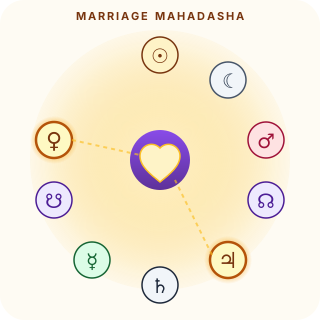
Vimshottari Mahadashas do not fire marriage evenly across life — some 20-year Mahadashas coincide with marriage 80% of the time; others rarely produce it. The classical marriage-trigger periods are Venus Mahadasha (20 years, strongest for male charts), Jupiter Mahadasha (16 years, especially for female charts), the 7th lord's own Mahadasha (whichever planet rules your 7th house), and — with important caveats — Rahu Mahadasha for unconventional-marriage patterns. Within any Mahadasha, the Venus-Jupiter and Jupiter-Venus Antardashas are the classical wedding-Antardasha combinations. This guide walks each Mahadasha's marriage-timing character, the Antardasha refinements, and the transit triggers that co-activate.
The framing — Mahadasha is the phase, Antardasha is the event
Think of the Vimshottari Dasha system as nested clocks. The Mahadasha (6-19 years long) sets the broad life-phase — the outer character of a chapter. The Antardasha (months to a couple of years) within that Mahadasha refines the timing to specific events. Marriage — as a specific dated event — almost always requires BOTH clocks to align on marriage-favouring signatures. A Venus Mahadasha alone will not necessarily bring marriage in any specific year; the marriage-favouring Antardasha WITHIN that Mahadasha does. Understanding this two-clock system is the difference between "marriage is likely in these ~5 years" and "marriage is most likely in this specific 12-month window."
For the underlying framework, see our Vimshottari Dasha explained guide. Here we focus on the Mahadashas most classically associated with marriage.
Even the strongest marriage-triggering Mahadasha does not guarantee marriage — it opens the window. Whether marriage happens depends on the chart's specific 7th house condition, the person's readiness, the world's cooperation, and the choices actually made. Read Mahadasha-based marriage timing as "when the astrological ground is fertile", not as "when the event will happen regardless." Astrology never overrides individual life circumstance.
Venus Mahadasha (20 years) — the strongest marriage-trigger period
Venus is the karaka of marriage for male charts and the karaka of romance, luxury, and partnership for all charts. Venus Mahadasha — the longest Vimshottari period at 20 years — is classically the most marriage-productive window. See our Venus in Vedic astrology guide for the fuller picture of Venus's significations.
Note: strict-BPHS practice per P.V.R. Narasimha Rao uses Venus as marriage-timing karaka for both genders, reserving Jupiter (in a woman's chart) for spouse longevity/health rather than timing. Under this convention, Venus Mahadasha is the strongest marriage-trigger regardless of gender. Both conventions are used in modern practice.
- Venus Mahadasha starting in your 20s — very often coincides with marriage in the first 5-7 years of the period. This is the classical "young Venus Mahadasha" pattern.
- Venus Mahadasha starting in your 30s or 40s — often still produces marriage if the person is unmarried, but the specific timing depends more on which Antardasha activates and on the 7th house condition.
- Venus Mahadasha starting after 50 (already married) — more commonly expresses as marital harmony, artistic success, financial prosperity, or a second marriage if the first has ended.
Venus Mahadasha's most marriage-favouring Antardashas: Venus-Jupiter (roughly the 3rd year of the 20-year Mahadasha, and again cyclically), Venus-Venus (the first ~3 years), Venus-Moon, and any Antardasha of the 7th lord within Venus Mahadasha.
When Venus Mahadasha does NOT bring marriage: if Venus itself is debilitated (in Virgo), combust (close to the Sun), or afflicted by malefics, Venus Mahadasha's marriage-triggering power is reduced. The Mahadasha still runs, but the marriage window may pass unmet.
Jupiter Mahadasha (16 years) — the classical marriage window for women
Jupiter is the karaka of husband in a female chart and the karaka of dharma, expansion, wealth, and children for all charts. Jupiter Mahadasha is often the primary marriage-trigger for women — many female charts show marriage arriving within the first 5-6 years of Jupiter Mahadasha. See our Jupiter guide for the full range.
- Female charts: Jupiter Mahadasha starting in the 20s or early 30s very often triggers marriage. The mother-in-law generation of Indian families used to say "as soon as Guru dasha starts, look for a boy" — a classical folk read that matches the technical reading.
- Male charts: Jupiter Mahadasha triggers marriage less directly than Venus Mahadasha, but strong Jupiter periods often coincide with the "meeting the future wife" phase, engagement formation, or first serious long-term partnership — even if the wedding happens in a later Mahadasha.
- Both genders: Jupiter Mahadasha triggers wealth accumulation, marriage, children, and dharmic learning windows.
Jupiter Mahadasha's most marriage-favouring Antardashas: Jupiter-Venus, Jupiter-Jupiter, Jupiter-Moon, and any Antardasha of the 7th lord within Jupiter Mahadasha.
Rahu Mahadasha (18 years) — unconventional or delayed marriage patterns
Rahu Mahadasha's relationship to marriage is more complex than Venus or Jupiter. Rahu is the karaka of unconventional paths, ambition, and boundary-crossing — his 18-year Mahadasha can trigger marriage, but usually of a specific type. See our Rahu guide.
- Marriage during Rahu Mahadasha often has an unconventional flavour: inter-caste, foreign spouse, love-marriage against family expectations, sudden or dramatic engagement, or marriage that surprises the community.
- Rahu Mahadasha's marriage-favouring Antardashas: Rahu-Venus (romance-with-unconventional-flavour), Rahu-Jupiter (marriage-with-family-blessing-eventually), Rahu-Mercury (marriage-through-work-connection).
- Rahu-Rahu Antardasha (first 2 years 8 months of the 18-year Mahadasha) is peak-confusion; marriage decisions made here often feel unclear later. Not a great sub-window for marriage.
- Rahu Mahadasha CAN delay marriage when the chart's 7th house is afflicted — Rahu amplifies whichever configuration is present. If the 7th is weak, Rahu can hold marriage back until Jupiter Mahadasha or the 7th lord's Antardasha activates.
Saturn Mahadasha (19 years) — the delay pattern
Saturn is the classical planet of delay, discipline, and structure. Saturn Mahadasha rarely triggers marriage as a primary event; more often, Saturn Mahadasha delays marriage that "should have happened" in an earlier Mahadasha, or produces marriage in its LATER years (year 12-19) rather than early. See our Saturn guide.
- Unmarried entering Saturn Mahadasha in the mid-20s: marriage often delays until the second half of the Mahadasha, or fires only in the Antardasha of a benefic (Saturn-Jupiter, Saturn-Venus).
- Saturn Mahadasha marriages tend to be more mature — older partner, longer-tenure relationships, marriages that survive external hardship. Delay-driven marriages often prove more stable long-term than sudden-Venus-Mahadasha romances.
- Saturn's marriage-favouring Antardashas: Saturn-Venus, Saturn-Jupiter, and any Antardasha of the 7th lord within Saturn Mahadasha.
- Saturn Mahadasha + Sade Sati overlap: compound Saturn pressure often delays marriage until both windows close.
For the specific delay pattern and how to work with it, see our Delayed Marriage guide.
The Antardasha refinement — which sub-periods fire marriage
Regardless of Mahadasha, certain Antardashas are classically flagged as wedding-Antardashas because they combine the marriage-karaka planets (Venus and Jupiter):
- Venus-Jupiter Antardasha — the strongest classical wedding-Antardasha combination. When this runs in any Mahadasha, marriage is astrologically strongly indicated.
- Jupiter-Venus Antardasha — the mirror combination; equally strong.
- Any Antardasha of the 7th lord within any Mahadasha — activates marriage themes directly.
- Antardashas of planets sitting in the 7th house in your natal chart — activate 7th house events during their run.
- Moon Antardasha in any Mahadasha — often triggers the "meeting the future partner" phase even if not the wedding itself.
The strongest classical timing convergence: a marriage-karaka Mahadasha (Venus or Jupiter) running WHILE a marriage-karaka or 7th-lord Antardasha is active, AND a favourable Jupiter transit is landing on the natal 7th house or the natal Moon. When all three lines up, marriage typically fires within that specific 6-12 month window.
When 7th lord's Dasha runs but marriage does not happen
A common question: "The 7th lord's Dasha or Antardasha is running — why has marriage not happened?" Classical Vedic tradition answers this several ways:
- 7th lord in a dusthana (6/8/12) natally. The 7th lord's Dasha still activates 7th-house themes, but the dusthana placement often expresses those themes as conflict, delay, or hidden partnership rather than a visible wedding. See our dusthana pattern guide for the general principle applied to career.
- 7th lord combust or debilitated. The Dasha runs but the karaka is weakened; marriage window opens but stays quiet.
- Malefic transit over the natal 7th during the Antardasha. Saturn or Rahu transiting the 7th can suppress marriage even when the Dasha would otherwise fire it.
- Personal readiness or life circumstance. Astrology does not force marriage on someone who is not ready or is not in a position to marry. The window opens; walking through it still requires the seeker's choice and circumstance.
Transit triggers that co-activate marriage windows
Even the perfect Dasha convergence typically needs a favourable transit to fire the actual wedding. The classical co-activators:
- Jupiter transit over the natal 7th house — the single most classical transit trigger. Jupiter takes ~12 months per sign; when he transits your 7th, marriage opportunities cluster.
- Jupiter transit over the natal 5th house — often triggers meeting-the-future-partner or engagement.
- Saturn transit over the natal 7th (slower — ~2.5 years) — often triggers mature-marriage or older-partner windows.
- Venus retrograde year during a Venus-active Dasha — either "marriage of unusual character" or "reconnection with a past partner."
- Rahu-Ketu axis transiting the 1st-7th axis — major life-restructuring window; sometimes marriage, sometimes divorce, sometimes unusual union.
Reading marriage timing honestly
The most reliable way to read your marriage timing: identify which Mahadasha you are currently in, name the marriage-favouring Antardashas within it (using the guides above), overlay the current and upcoming Jupiter transit path over your natal 7th house, and see when the three lines converge. That window — usually 6-12 months when all three align — is your astrologically strongest marriage-triggering period. For a broader read on marriage timing indicators beyond just Dasha, see our general Marriage Timing guide.
For your specific current Dasha and upcoming Antardashas — generate your free Janma Kundli on Shubh Bhagya and check the Dasha panel.