If you have a recurring or worsening health issue, the first step is a qualified medical professional — not a chart reading. Modern medicine has diagnostic tools and treatments that no classical text can substitute for. Vedic astrology reads the karmic weather of a health pattern; medicine reads the biology. Use them together, never one instead of the other. If any practitioner tells you to skip a doctor "because the remedy will handle it," walk away.
If a health issue keeps coming back — the same infection every few months, the same joint flaring, the same digestive complaint, the same low-grade fatigue you cannot shake — classical Vedic astrology has a specific framework for understanding the karmic side of the pattern. This guide walks through the seven chart signals: Ascendant lord (constitution), 6th house (Roga Bhava), 8th house (chronic and hidden conditions), planetary karakas (Sun / Moon / Mars / Mercury for their body domains), current Dasha and Antardasha, Sade Sati and Ashtama Shani transits, and the Kalapurusha body-region mapping. The point is to name the pattern honestly and place it alongside medical care.
Why the chart shows health at all
Vedic astrology treats the body as a temporary configuration of the same five elements (earth, water, fire, air, ether) that make up the rashis and the grahas. Because the body is built out of the same substances the chart maps, the chart reveals which regions and tissues are structurally strong and which are structurally vulnerable. It does not diagnose disease. It describes where the weather turns bad and when.
Classical Vedic tradition holds that the 6th house is Roga Bhava (the house of disease), the 8th house is the house of chronic and hidden conditions and of longevity, and the Ascendant with its lord describes the constitution itself. Each of the seven visible grahas rules a specific body tissue (a dhatu), and each of the twelve rashis rules a specific body region through the Kalapurusha (cosmic body) mapping. When these signals converge on the same domain, that domain often becomes the health story of the life.
Vedic astrology does not cause or cure disease. It describes patterns — some charts carry robust health, some carry a specific vulnerability, most sit in between. What good chart analysis does is tell you (1) which body regions are most likely to need attention across your life, (2) which Dasha windows have historically brought health themes to the surface, and (3) which classical practices support the specific afflicted karaka. It works alongside preventive medicine, not against it. Anyone selling a "health nivaran puja" package for tens of thousands of rupees is exploiting fear, not tradition.
Signal 1: The Ascendant lord (Lagnesh) — your constitution
The Ascendant (Lagna) and its lord (the Lagnesh) describe your basic constitution — the body's underlying vitality, resilience to illness, and general health signature. Everything else in a health reading rests on this foundation.
What to check
- Which sign is on your Ascendant? The sign colours the constitutional type. Fire ascendants (Aries, Leo, Sagittarius) tend toward heat-related conditions and a wiry active body. Earth ascendants (Taurus, Virgo, Capricorn) tend toward slower metabolism and structural conditions. Air ascendants (Gemini, Libra, Aquarius) tend toward nervous-system and respiratory patterns. Water ascendants (Cancer, Scorpio, Pisces) tend toward emotional and fluid-related conditions.
- Where is your Ascendant lord placed? Best positions: 1st, 4th, 5th, 9th, 10th, 11th. Concerning positions: 6th, 8th, 12th (the dusthanas) — these often correspond to constitutional vulnerability from the start of life.
- Is your Ascendant lord conjoined with malefics? Saturn, Mars, Rahu, or Ketu conjoining the Lagnesh often colours the constitution with that planet's specific difficulty pattern (Saturn = slow chronic; Mars = acute/inflammatory; Rahu = unusual or hard-to-diagnose; Ketu = mysterious detachment).
- Is your Ascendant lord aspected by Jupiter? Jupiter's aspect on the Lagnesh is one of the strongest classical protectors of constitutional health.
Signal 2: The 6th house (Roga Bhava — the disease house)
The 6th house is Roga Bhava — the house of daily illness, infection, immune-system function, and the everyday battles of the body. It is a dusthana (difficult house), and yet it is also an Upachaya (growing) house — which produces a specific classical rule: malefics in the 6th are actually protective, because they defeat disease.
What to check
- Which planet rules your 6th house? That is your 6th lord — its placement often reveals where your health battles tend to concentrate.
- Where is your 6th lord placed? A 6th lord in the 6th, 8th, or 12th (its own dusthana or another) is often protective in a peculiar way — the classical Vipareeta Raja pattern for health, especially Harsha Yoga (6th lord in the 6th itself) which is one of the strongest classical protectors against chronic illness. A 6th lord in a good house sometimes has the opposite effect — carrying the 6th's difficulty into the good house.
- Is your 6th house occupied by any planet? Mars or Saturn in the 6th is classically protective (they defeat enemies and disease from inside the house). Jupiter or Venus in the 6th is not desired — a benefic in the 6th weakens the house's protective quality (classical rule from the tradition).
- Which rashi is on your 6th house? The body region ruled by that rashi (via the Kalapurusha mapping) is often the site where health themes recur.
Signal 3: The 8th house (chronic and hidden conditions, longevity)
The 8th house is Ayur Bhava — the house of longevity, chronic conditions, hidden illness, and slow-developing disease. Where the 6th governs acute disease that flares and passes, the 8th governs conditions that sit for years, sometimes for a lifetime.
What to check
- Which planet rules your 8th house? A weak or afflicted 8th lord often correlates with chronic patterns — the conditions that do not respond quickly to short-term treatment.
- Where is your 8th lord placed? An 8th lord in the 8th itself is Sarala Yoga — the classical Vipareeta Raja for longevity and freedom from chronic disease. An 8th lord in the 6th or 12th continues the dusthana-in-dusthana protective pattern. An 8th lord badly placed in a benefic house often pulls the 8th's chronic energy into that house's affairs.
- Is your 8th house occupied? The Moon in the 8th is one of the classical Balarishta (child-mortality) combinations in the older texts and, in adult life, often correlates with emotional-fluid-related chronic patterns. Saturn in the 8th, well-placed, is classically good for long life; Saturn in the 8th, afflicted, is the "chronic-condition-that-defines-decades" signature.
- Is Saturn also strong in the chart? Saturn is the karaka of longevity (Ayushkaraka). A strong Saturn together with a strong 8th house is one of the classical long-life signatures.
Signal 4: The planetary karakas — dhatu and body-tissue rulership
Each visible graha rules a specific body tissue (dhatu) and a specific body domain. When a planet is afflicted in your chart, the tissue and domain it rules often show up as the recurring health issue.
The classical dhatu mapping
- Sun — bones, heart, right eye (for men) / left eye (for women), vitality. Weak Sun often correlates with bone/skeletal weakness, cardiovascular themes, low overall vitality, or eye issues.
- Moon — blood, body fluids, mental/emotional health, left eye (for men) / right eye (for women). Weak Moon often correlates with blood or fluid-related conditions (anaemia, oedema, hormonal), and with anxiety, depression, or mood-related chronic patterns.
- Mars — marrow, muscles (in some classical readings), blood-heat, and injuries. Afflicted Mars often correlates with injury patterns, inflammatory conditions, blood-heat disorders, and surgical events.
- Mercury — skin and nervous system. Afflicted Mercury often correlates with skin conditions, nervous-system issues, allergies, and speech or communication-related health themes.
- Jupiter — fat and liver. Afflicted Jupiter often correlates with lipid disorders, liver conditions, weight themes, and metabolic patterns.
- Venus — reproductive system, kidney and urinary domain. Afflicted Venus often correlates with reproductive or urinary themes and kidney-related conditions.
- Saturn — muscles, joints, chronic conditions, ageing. Afflicted Saturn is the karaka of chronic illness itself — its placement often reveals which specific chronic pattern is most likely to visit.
- Rahu — mysterious, hard-to-diagnose, allergy-like, and modern-lifestyle patterns. Rahu often correlates with conditions that do not fit a single classical diagnosis.
- Ketu — spiritual dimensions of health, viral patterns, and conditions with a mysterious spontaneous quality. Often correlates with immune-system patterns.
How to use the dhatu map
Identify the two or three planets in your chart that are most afflicted — combust, debilitated, in a dusthana, aspected by multiple malefics, or badly conjoined. The dhatu and body domain of those planets are the areas the chart is pointing toward. This does not mean disease is inevitable there. It means those are the domains where preventive attention will pay the highest dividend.
Signal 5: Current Dasha, Antardasha, and health windows
Health themes tend to cluster in specific Vimshottari Dasha windows. Not all periods of life bring the same likelihood of a chronic issue surfacing. Recognising which window you are in often explains why an issue arrived when it did.
What to check
- Which planet's Mahadasha are you in right now? If it is a natural malefic (Saturn, Mars, Rahu, Ketu) placed in your 6th, 8th, or 12th house, health themes are structurally more likely to surface during this period.
- Which Antardasha (sub-period) is running? The sub-period times the specific event. A Mars Antardasha within a difficult Mahadasha often correlates with acute inflammatory flares; a Saturn Antardasha with chronic slow-developing patterns; a Ketu Antardasha with mysterious or difficult-to-diagnose events.
- Is the current Dasha ruler your 6th or 8th lord? If yes, health themes are heavily foregrounded. This is the classical signature for "the chronic condition that finally surfaces in this decade."
- Is the current Dasha ruler badly placed? A well-placed 8th-lord Dasha is often protective; a badly placed one is the classical difficulty period.
What this looks like in practice
A common pattern in the readings we see: a person in their late thirties who has been broadly healthy suddenly develops a recurring immune-system condition. Chart analysis shows they are three years into a Saturn Mahadasha, and the current Saturn-Rahu Antardasha activates a Rahu placed in their 6th house. The condition itself needs medical care — that is unambiguous and non-negotiable. But the astrological read gives useful context: the pattern is likely to remain active for the duration of this Antardasha (about two more years), soften significantly when the next Antardasha begins, and the classical remedy focus is on both Saturn and Rahu together. Knowing the shape of the weather does not fix the condition. It helps the person plan around it — pace their work, invest in preventive support, and stop treating each flare as a mysterious personal failure.
Signal 6: Sade Sati, Ashtama Shani, and Rahu-Ketu health transits
Certain transiting patterns are classically associated with health themes surfacing. These are not deterministic, but they map so consistently to health-difficulty periods that classical texts flag them specifically.
Sade Sati
Sade Sati is the roughly 7.5-year period when Saturn transits the sign before your natal Moon, the sign of your Moon, and the sign after. See our Sade Sati guide for the full walkthrough. From a health perspective, Sade Sati often surfaces chronic patterns that have been latent — the body's slow accumulation of stress starts to show as recurring themes during this window, particularly in the middle phase when Saturn transits directly over the natal Moon (mental-fluid-emotional axis).
Ashtama Shani (Saturn's transit through the 8th from Moon)
Ashtama Shani is Saturn's roughly 2.5-year transit through the 8th sign from your natal Moon. Classical Vedic tradition holds this as one of the more health-active transit periods — the 8th being the house of chronic conditions and longevity, and Saturn being the karaka of both. Ashtama Shani does not mean illness is certain. It means the period is one to invest in preventive care, sleep hygiene, and honest engagement with any nagging symptoms rather than pushing through.
Rahu-Ketu transits over sensitive points
When Rahu or Ketu transits over your natal Sun, Moon, Ascendant lord, or the ruler of your 6th or 8th house, health themes often surface with a particular unusual quality. Rahu-transiting-Sun periods have been associated in the tradition with cardiovascular or vitality themes; Rahu-transiting-Moon with mental-emotional patterns; and Ketu transits with conditions that appear and disappear mysteriously.
Signal 7: The larger karmic pattern — Kalapurusha body regions
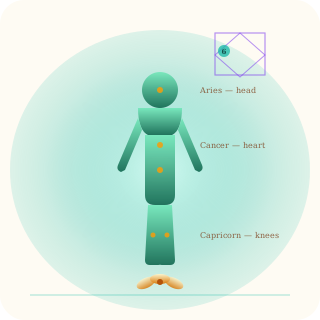
The subtler signal that often ties a health pattern to a specific body region. Classical Vedic tradition maps each rashi to a specific body region on the cosmic body (Kalapurusha) — see the classical mapping in the Vedic zodiac tradition:
- Aries — head, brain
- Taurus — face, throat, neck
- Gemini — arms, shoulders, lungs
- Cancer — chest, heart, stomach (upper)
- Leo — heart, spine, upper back
- Virgo — intestines, lower digestive tract, hips
- Libra — lower abdomen, kidneys, space below navel
- Scorpio — reproductive organs, private parts
- Sagittarius — thighs, hips
- Capricorn — knees, joints
- Aquarius — ankles, calves, circulation
- Pisces — feet, lymphatic system
The reading rule: identify which sign your afflicting planet occupies. That sign's body region is often the site where the pattern shows up. If your Saturn is in Cancer and heavily afflicted, the chest, heart, and upper-digestive area is where classical texts would direct attention. If your Mars is in Capricorn and afflicted, joints and knees are the classical zone.
The most decisive health readings usually come from combining the dhatu (planet-tissue) map from Signal 4 with the Kalapurusha (sign-body-region) map from Signal 7. When an afflicted planet's dhatu AND its occupied sign's body region point to the same domain, that domain is the strongest chart signal for a health theme. When they point to different domains, both may show up but neither with the same intensity as when they converge.
What to do when you have identified the pattern
1. See a doctor first — always
Recurring or worsening health issues need medical evaluation. Modern medicine has diagnostic tools (imaging, blood work, specialist assessment) that no chart reading can replace. Astrology names karmic weather; medicine names biological reality. Neither is optional. If a practitioner tells you to skip medical care because a remedy will "handle it," they are not practicing classical Vedic tradition — they are trading on fear.
2. Engage classical remedies for the specific chart pattern
The classical remedies most commonly used for health-related afflictions:
- Mahamrityunjaya Mantra: the classical Shiva mantra recited for health, longevity, and protection from disease. Widely accepted across Vedic traditions and safe to practice without specialist consultation. The most important general-purpose health mantra in classical Vedic tradition.
- Dhanvantari worship: Dhanvantari is the classical deity of healing and Ayurveda. Devotional worship is a classical health-supportive practice.
- For Saturn (chronic conditions): Vishnu worship (Vishnu is Saturn's classical deity), Saturday fasting, service to the elderly and to manual labourers, donation of black sesame or iron. See our Saturn Remedies guide.
- For Sun (vitality, heart, bones): visiting or giving to a temple (the Sun's classical good deed), Aditya Hridayam recitation, offering arghya (water) to the rising Sun on Sundays.
- For Moon (blood, fluid, mental-emotional): Devi worship, Monday fasting, donation of rice or milk, and — importantly — genuine mental-health support (therapy, sleep discipline) alongside the classical practice.
- For Mars (blood-heat, injury, surgical): Hanuman worship, Tuesday fasting, physical exercise, blood donation as a specifically classical Mars remedy.
- For Mercury (skin, nervous system): Vishnu worship, Wednesday practice, service to scholars.
- For Jupiter (metabolism, liver): Guru mantra, Thursday fasting, donation of chick peas or turmeric. See our Jupiter Remedies guide.
- For Rahu (unusual or hard-to-diagnose conditions): Rahu mantra, Durga worship, donation of black gram.
- For Ketu (mysterious or immune conditions): Ganesha worship, meditation, and — where the chart supports it — engagement with a spiritual practice as part of the healing work.
3. Address the pattern honestly
Sometimes a chart's health signature is pointing at a specific lifestyle domain where the person has been fighting the pattern rather than working with it. A weak Sun with cardiovascular themes benefits from early-morning practice and honest engagement with rest; a weak Moon with mental-health themes benefits from sleep discipline and reduced screen time; an afflicted Saturn benefits from disciplined pacing and refusal to overwork; a Mars-Mercury nervous-system pattern benefits from actively reducing chronic stress load. Vedic astrology does not replace lifestyle medicine or therapy — it points at the domain where the work needs to happen and provides classical practices that support the work.
What NOT to do
- Do NOT skip medical care. Any practitioner who tells you a remedy alone will handle a serious health issue is not a classical astrologer. Genuine tradition places astrology alongside, not instead of, appropriate medicine.
- Do NOT buy expensive "health nivaran puja" packages. Any priest asking for tens of thousands of rupees for a health-focused ceremony is trading on fear, not tradition. Genuine remedies are simple and inexpensive.
- Do NOT wear gemstones for a specific planet without a full chart consultation. The wrong stone can strengthen an afflicting planet. Yellow sapphire, blue sapphire, and red coral all carry real risk of worsening a chart when worn without proper analysis.
- Do NOT read a difficult chart as a verdict. A chart describes weather, not fate. Many people with challenging health signatures live long healthy lives through preventive care, disciplined lifestyle, and honest engagement with the domains the chart is pointing at. And many people with technically clean charts still fall ill — the chart is one lens, not the only one.
- Do NOT let anyone tell you a specific illness is "caused by" a specific planet in a mechanical sense. Vedic tradition is more subtle than that — the chart shows tendencies and vulnerabilities, not straight-line causation.
Check your own chart
Generate your free Janma Kundli on Shubh Bhagya. The result page shows your Ascendant lord, 6th and 8th houses and their lords, planetary placements including afflictions, and current Dasha and Antardasha. Walk through the seven signals above yourself. Our Saturn primer and Sade Sati guide go deeper on the transit side. Our Saturn Remedies and Jupiter Remedies guides cover the two most common health-related remedy sets. If you have a specific question about your chart — "which Dasha window is my chronic condition tied to?" or "which of my afflicted planets is the primary driver?" — the Ask Shubh Bhagya feature can answer it against your actual chart.
Chronic health is real, patterned, and often carries a chart signature that becomes clearer once you know where to look. Understanding your specific pattern is the first step toward knowing whether the honest answer is preventive care in a specific body region, patience through a Dasha window, classical remedy for a specific afflicting planet, or all three together — with a doctor's care as the anchor beneath all of it.