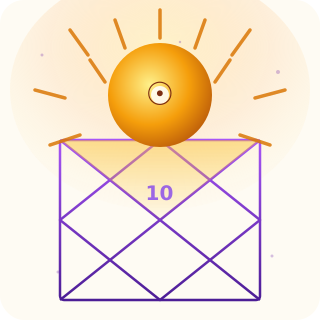
Sun in the 10th house is one of the strongest career placements in Vedic astrology. The Sun is the natural significator of the 10th house (Karma Bhava) and gets digbala — his directional strength — from here. Classical texts frame this as the "kingly placement": authority, name, and public standing tend to arrive without the person having to fight for them. But it is not automatic. A strong Sun in the 10th produces natural leadership; a weak or afflicted Sun in the same house produces ego problems, conflict with authority, and father-related struggles. This guide walks through the placement's real range, per-ascendant variations, when it activates, what it says about the father, and honest remedies scoped to the actual condition of your Sun.
What "Sun in the 10th house" actually means
The 10th house — Karma Bhava — is the primary house of career, profession, public reputation, and worldly action. It is what you become known for, the mark you leave, the role you play in society. Every planet says something specific when placed here, but the Sun says the most, because Sun is the natural karaka (significator) of the 10th house itself.
Classical Vedic teaching goes further: the 10th house is where Sun gets digbala, his directional strength. Digbala is not a small technical detail — it is one of the six sources of planetary strength (shadbala) and it means the planet expresses its most confident, most stable, most authentic qualities from this position. Sun in the 10th is the king seated in his throne room, presiding over his own domain.
The result, classically, is a person who carries authority naturally rather than having to build it. Whether that authority translates into a formal position — government, leadership, executive role — or into something quieter but still magnetic — a doctor everyone trusts, a teacher whose students remember them for life, a family patriarch whose word settles disputes — depends on the rest of the chart. But the underlying pattern is the same: people notice this person. For a fuller picture of what Sun does anywhere in a chart before we get into what happens when he sits in the 10th, see our Sun in Vedic astrology guide.
Astrology describes patterns, not fixed outcomes. Sun in the 10th house is a strong placement, but "strong" is not the same as "easy". The Sun's fire, when well-placed, warms and illuminates; when hot and unregulated, it burns. Two people with identical Sun-in-10th placements can turn out very differently depending on Sun's sign, aspects, Dasha timing, and — most importantly — the choices they make about how to hold authority. The chart shows the terrain. The walking is still yours.
When Sun in the 10th is strong: the natural authority pattern
A well-placed Sun in the 10th — meaning in his own sign (Leo), exalted (Aries), or otherwise dignified and free of affliction — tends to produce a strikingly consistent career arc:
- Early recognition. Unlike the delayed-peak pattern of Saturn in the 10th, Sun-in-10 natives are often visible from young. Teachers single them out. First jobs come with early responsibility. By their late twenties or early thirties they are already being pulled into leadership.
- Positions of visible authority. Government, judiciary, medicine, family business at the head, senior corporate roles, politics, or any career where the person is seen. The Sun does not thrive in anonymous back-office work; he needs an audience.
- A magnetic quality. Others describe them as "presidential", "commanding", "hard to ignore". They walk into rooms and rearrange the attention. This is not something they engineer; it is a byproduct of Sun's placement.
- A father who was — or is — a strong figure. Sun is the karaka of the father. A well-placed Sun in the 10th usually indicates a father who was successful, respected, or otherwise a formative model of authority. The person often inherits the father's field, the father's name, or the father's expectations.
- Reputation that outlasts the role. Even after formal position ends, the aura remains. Retired Sun-10 natives often become the elder statesman of their field.
Classical Vedic tradition considers this placement one of the natural signatures for government service, judicial roles, medicine, and public leadership. When you see "Rajya Yoga" (kingdom-like career) in old texts, a well-placed Sun in the 10th is one of the most common configurations behind it.
When Sun in the 10th is weak: the shadow pattern
The same house that houses digbala can also house real difficulty when the Sun himself is compromised. Three configurations that flip the pattern:
- Debilitated Sun in the 10th (Libra 10th house, Capricorn ascendant). Sun in Libra is his deepest debilitation. In the 10th house, this often produces the "capable person who cannot get promoted" pattern — the work is excellent, the visibility is dim, authority feels borrowed. We cover this in depth in the debilitated Sun career guide; check the Neecha Bhanga cancellation rules there, because for many Capricorn ascendants this debilitation is actually cancelled and the placement inverts into unusual strength.
- Combust Sun in the 10th. When another planet sits within about 8 degrees of the Sun, that planet becomes "combust" — its significations get burned by Sun's brightness. But the reverse can happen too: if the 10th lord itself is combust by the Sun, career visibility can be paradoxically diminished. The person is doing the work but the recognition keeps going to someone else. Mercury combust in the 10th, for example, can indicate analytical skill that is never quite credited.
- Sun in the 10th with malefic aspects. A well-placed Sun aspected by Saturn from the 4th, 7th, or 12th tends to produce a career of chronic frustration under authority — the Sun's confidence keeps getting compressed by Saturn's restriction. Sun with Rahu in the 10th can create the "meteoric-then-scandalous" pattern — sudden fame followed by reputation crises. Sun with Ketu in the 10th often produces someone who reaches high position but feels detached from it.
The ego trap is real for all Sun-10 natives, but especially so when the Sun is only moderately dignified. The kingly principle, unrefined, becomes arrogance; unmoored, becomes ego-driven decision-making that alienates the very audience the Sun needs. This is the placement's shadow: authority without wisdom hardens into insecurity that masquerades as pride.
How Sun in the 10th plays out per ascendant
The sign in which your 10th house falls dramatically shapes how Sun behaves there. A few of the most consequential configurations:
- Cancer ascendant — Sun exalted in Aries in the 10th. This is one of the finest Sun placements in the entire zodiac. Sun is exalted, gets digbala, and Sun is the 2nd lord for Cancer (wealth, family, speech) — the placement classically produces exceptional career elevation, strong public reputation, and family-name honor. Government service, judiciary, and top-tier professional careers are common signatures.
- Scorpio ascendant — Sun in his own sign Leo in the 10th. Sun in own sign in his own natural house with digbala. Classical texts flag this as an outstanding career placement. The person often carries a natural gravitas from young; authority feels effortless. Careers in leadership, medicine, defense, and public administration are common.
- Aries ascendant — Sun in Capricorn in the 10th. Sun is the 5th lord placed in the 10th (a classical Rajya Yoga because 5th and 10th are both trine/kendra combinations). Capricorn is Saturn's sign, so the Sun here works through discipline, structure, and hierarchy. Careers in government, administration, engineering, or large institutional roles are common. Recognition comes but often after visible effort — the Sun has to prove himself in Saturn's territory.
- Capricorn ascendant — Sun debilitated in Libra in the 10th. The hardest baseline for direct authority. Career often builds through negotiation, consulting, or advisory rather than command. However — and this matters — many Capricorn ascendants have Neecha Bhanga conditions active (Saturn or Venus in kendra, Mars in kendra, or Sun exalted in the D-9 chart) that cancel the debilitation. When cancelled, the placement can produce late-career elevation that other charts never see. Do not read this as a fixed sentence.
- Leo ascendant — Sun as lagnesh in the 10th. Sun is not in Leo here (Leo's 10th is Taurus) but the lagnesh sitting in the 10th is itself a classical strength. This produces the "self-made public figure" pattern — career achievements become identity, identity becomes career. Personal branding, entertainment, hospitality, and creative-industry leadership are common signatures.
- Sagittarius ascendant — Sun in Virgo in the 10th. Sun in Mercury's earthy sign in the 10th produces analytical authority — the person often becomes known for expertise rather than charisma. Careers in medicine, technical writing, precision-oriented professions, and quality-focused roles are common.
- Other ascendants. Every combination has a distinct pattern; the through-line is that Sun's dignity plus his sign lord's condition determines whether Sun-in-10 elevates or exposes. For any specific configuration, generate your free Janma Kundli to see your own Sun's exact sign, degree, and aspects.
When Sun in the 10th activates: the timing question
Placement describes potential; Dasha describes when the potential comes online. Sun in the 10th tends to peak in three timing windows:
- Sun Mahadasha (6 years). The most direct activation window. During Sun's own Mahadasha, the placement in the 10th house tends to deliver its clearest career results — recognition, promotions, entry into positions of visible authority. If Sun is strong, this period is often the career high-point. If Sun is weak, this period can bring authority conflicts and ego-driven mistakes. See our Sun Mahadasha guide for the full pattern.
- Sun Antardasha within another Mahadasha. Shorter (roughly 3-11 months depending on the Mahadasha lord), but often produces smaller versions of the same Sun-in-10 signature: unexpected recognition, promotion opportunities, contact with authority figures.
- Transit windows. Jupiter transiting the 10th house, the natal Sun, or aspecting the 10th house from the 6th; Saturn's 10th aspect landing on the natal Sun; and the annual Sun-return (when transiting Sun re-enters the natal Sun's sign) all tend to activate Sun-in-10 themes. These are shorter-window activations but frequently line up with career inflection points.
Sun in the 10th and the father
Sun is the karaka of the father (Pitru Karaka). His placement in the 10th house always has something to say about the father's role in the person's life — often more than the person consciously realises. The pattern tends to fall into a few configurations:
- Strong Sun in the 10th: the father is usually a successful, career-focused, respected figure — often the person's first model of public authority. Career choices frequently mirror or react against the father's field. Family name matters.
- Weak Sun in the 10th: the father may be present but not fully authoritative — successful in some domains but complicated in others. The person often has to construct their own model of authority because the inherited one felt insufficient.
- Sun-Saturn conjunction in the 10th (Surya-Shani yoga): a classically difficult signature. Father and child often compete on career terrain, or the father's shadow feels heavy across the person's own achievements. The person may achieve significantly, and still feel the achievement is measured against a standard the father set.
- Sun-Rahu in the 10th: the father may be foreign, unconventional, or unusually influential in an unorthodox way. The person often carries a complicated relationship with authority as a result.
None of these are fixed. The father-Sun signature is one of the most therapy-worthy configurations in a chart, and consciously working through it often shifts the pattern. Astrology describes the setup, not the ending.
Remedies for Sun in the 10th, scoped to your Sun's condition
Remedies for Sun in the 10th house are not a single prescription. Whether the Sun needs strengthening (if weak) or calming (if too fierce) determines what actually helps.
If your Sun is dignified but you want to support its expression:
- Visit a temple, or give to one. A temple visit, a donation to a temple, or help with its running is the Sun's classical good deed. Shiva and Rama are the Sun's deities, so a Shiva or Rama temple is a natural choice.
- Aditya Hridaya Stotram. The Sun-praise hymn Rama recited before defeating Ravana. Recited daily at sunrise, it is considered a general Sun-supporting practice with no adverse effect.
- Water offering (Arghya) at sunrise. Copper vessel, water with a few grains of red sandalwood or a red flower, offered facing the rising Sun. Traditional and gentle.
If your Sun is weak, debilitated, or combust:
- All of the above, more consistently. A weak Sun benefits from daily rather than occasional practice.
- Serving or honoring the father. Sun is Pitru Karaka; genuine care for the father (or father-figures if he is gone) is considered the most direct remedy for any Sun affliction.
- Sunday charity. Wheat, jaggery, red items (red cloth, copper) donated to those genuinely in need on Sundays. Traditional and effective when done without ego.
If your Sun is overly fierce (dignified but with ego problems):
- Sun-cooling practices. Water offerings, moon-strengthening practices, meditation, and consciously working on humility. The classical prescription for an over-hot Sun is not more Sun energy — it is balance.
Ruby (Manik) is the classical gemstone for Sun, but wearing a ruby without a specific chart consultation can amplify Sun's afflicted expression as easily as its strong one. If your Sun is combust, debilitated, or heavily afflicted, a ruby can make things worse rather than better. Please consult a knowledgeable astrologer before wearing any gemstone remedy. The other remedies listed here — practice, service, charity — are safe for any Sun configuration.
Reading Sun-in-10th honestly
The most common mistake people make with this placement is assuming that any Sun in the 10th automatically produces the classical outcomes — government job, name, authority, honored career. Sun in the 10th produces the capacity for these outcomes; whether they arrive depends on Sun's dignity, current Dasha, aspects, and — genuinely — the choices the person makes about how to hold authority when it comes.
The second most common mistake is the reverse: assuming that a difficult Sun in the 10th (debilitated, combust, afflicted) forecloses the career-authority theme entirely. It doesn't. Neecha Bhanga cancels debilitation. Combustion recedes when the involved planets separate under transit. Malefic aspects loosen as those planets progress through their own transits. Charts are dynamic; the difficult version of Sun-in-10 at age 28 can become the mature Sun-in-10 at age 42.
The honest read on Sun in the 10th is that it is one of the strongest natural placements for career visibility in the Vedic system — but the placement demands that you learn to hold power without letting it hold you. Do that, and the classical outcomes tend to arrive. Skip that step, and the placement can produce a career that looks successful from the outside and feels hollow from within.