Numerology is a modern Western tradition, not classical Vedic Jyotish. The foundational Sanskrit texts — Brihat Parashara Hora Shastra, Brihat Jataka, Saravali, Phaladeepika — describe nothing like English-alphabet name numerology. This article is honest about which tradition it is drawing on. If you want a reading from the classical sources this site is built on, generate your free Janma Kundli instead.
In name numerology the name that counts is the one people actually call you — not the one printed on your documents. Your birth date is fixed and cannot be entered wrongly; your name is the part a reading can get wrong. Everything below is about getting that input right.
Two numbers, two different jobs
Name numerology works with two numbers that answer different questions.
Your birth number comes from the day of the month you were born, reduced to a single digit. Born on the 23rd? 2 + 3 = 5. It is fixed for life, and in this tradition it speaks to what Cheiro called the material side of life — the practical, outward, worldly track of things.
Your name number comes from adding up the letters of your name on the Chaldean table. It speaks to the inner side: temperament, what you are drawn to, the texture of how you move through the world rather than the events themselves.
The important asymmetry is this. The birth number is a fact — you cannot mistype your own birth date in a way that produces a plausible wrong answer. The name number is a choice, because most people answer to more than one name. That is where readings go wrong, and it is the question this whole article exists to settle.
Which name actually counts
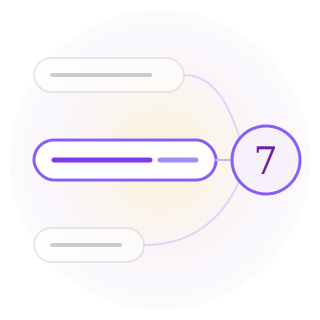
The rule is older than it sounds and it is refreshingly practical: use the name you are most known by.
Cheiro — the Irish palmist and numerologist whose tables are the ones circulating in Indian numerology books today — is direct about it. It is the most-used given name and surname together that produce your key number. And where the surname is more in evidence than the given name, the surname is the one that is taken.
So the test is not what appears on your passport. It is what people say when they are talking about you.
- If you have several given names, use only the one you are actually known by. A man baptised with four names who has answered to one of them since childhood should count that one.
- If people mostly use your surname — common in workplaces, in the army, at school — then the surname carries the number.
- If you go by a shortened form, that shortened form is your name for this purpose. Not the long version you stopped using at fourteen.
You are allowed to have two
This is the part most calculators never mention, and it is the most useful idea in Cheiro's name material.
A person can legitimately carry two name numbers at once. Someone always addressed formally at work — Cheiro's example is a woman known as "Miss Jones" — should compute that name and use it, but only in relation to the business she is employed in. For her home life and private affairs she should work out the name she is actually called by at home, or the pet name she is known under.
The two are not in competition. They govern different rooms of the same life. A trade name that runs your professional world says nothing about the name your family uses, and the tradition does not ask you to pick one.
If your work life and home life use genuinely different names, run the calculator twice — once with each. Read the first against your career and the second against your private life. That is closer to how the tradition intends it than forcing one name to answer both.
Spelling is not cosmetic
Because every letter carries a value, changing a letter changes the number. Cheiro's own example is Napoleon dropping the u from Buonaparte — the shortened spelling scores differently, and he treats the change as consequential rather than clerical.
For Indian names written in English this matters more than it does anywhere else, because transliteration is genuinely unsettled. Sanjay and Sanjai are different numbers. So are Shubh and Subh, Lakshmi and Laxmi, Krishna and Krishn. None of these spellings is wrong. But they are not interchangeable for this purpose, and a calculator that quietly scores one of them is answering a slightly different question than you asked.
The practical rule: score the spelling you actually write. If you sign your name one way and your certificates say another, the one in daily use is the one the tradition wants.
When your two numbers agree
There is a neat confidence check built into the system. If the name you believe is the right one produces the same number as your birth number — or the same number at another depth, like a name totalling 11 against a birth number of 2 — then you can be confident you have picked the correct name to read.
Read that carefully, because it is easy to inflate. Agreement is evidence about your input, not a promise about your life. The birth number is the reliable one; the name is the uncertain one; when they land on the same number, the uncertain one has been corroborated. That is all it claims, and it is genuinely useful for exactly that.
Names that do not agree are entirely ordinary. Most do not. They simply do not offer this particular cross-check.
The compound number behind the single
Add up your name's letters and you get a raw total — 19, or 34, or 47 — before it is reduced to a single digit. That raw total is the compound number, and it carries its own meaning alongside the reduced one.
The two are read together, never one instead of the other. In this tradition the single numbers speak to the material side of things and the compounds to the inner side, so the compound colours a reading rather than overruling it. A difficult-sounding compound sitting alongside a fortunate single is read very differently from the same compound alone.
The compound series runs from 10 to 52 — 52 because it stands for the weeks of the year. And the descriptions read like pictures rather than adjectives ("the Wheel of Fortune", "a Shattered Citadel") because the symbolism was handed down in images, not word-lists.
What this cannot do
Worth stating plainly, because numerology is often sold past its limits.
- It cannot time events. Marriage timing, career changes, the shape of a difficult year — those need chart-based Jyotish, which reads the actual positions of the planets at your birth.
- It is not a second opinion on your Kundli. These are separate systems from separate civilisations. When they agree it is worth noticing; when they disagree, neither is refuting the other.
- A name number is not a verdict. No number here is a sentence, and any reading that tells you a number dooms you has left the tradition behind.
Where to go next
- Run your own numbers — enter the name you are actually known by and see your birth number, name number, compound and the agreement check together.
- Check two people — the same numbers read as a pair.
- Get your free Janma Kundli — the classical Vedic reading this site is built for, from an entirely different and much older tradition.
The most useful thing name numerology asks is a question worth sitting with regardless of whether you believe the numbers: which name do people actually call you? Most of us carry several — the formal one, the family one, the one only old friends use. Noticing which one has become the real one tells you something about your life that has nothing to do with arithmetic.