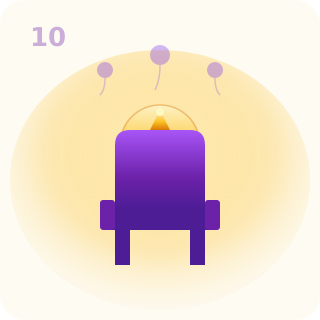
Magha is the tenth nakshatra — Leo 0°00' to 13°20'. Its archetype is the royal throne of the ancestors — authority inherited from lineage, dignity carried without effort, the responsibility of the eldest. Ruled by Ketu with the Pitris (departed ancestors) as its deities, symbolised by a royal throne, Magha natives carry the classical weight and grace of the ancestral seat.
Magha at a glance
- Sanskrit name: Maghā (मघा) — "the mighty one" / "the great"
- Zodiac range: Leo 0°00' to 13°20' (sidereal) — the first third of Leo
- Ruling planet: Ketu — the south lunar node, significator of moksha, past-life karma, and dissolution of ego
- Deities: The Pitris — the collective ancestors, especially the paternal line
- Symbol: A royal throne (Simhasana); a palanquin
- Gana: Rakshasa (intense, driven temperament)
- Guna: Tamas (deep, containing quality)
- Yoni: Rat (paired with Purva Phalguni)
- Nadi: Antya (Kapha / earth-water dosha)
- Nature (activity): Ugra (fierce) — for confrontation, powerful action; not for weddings
The paradox: Ketu-ruled but throne-symbolised
Magha carries one of the most striking paradoxes in the nakshatra system. Its symbol is the royal throne — the seat of power, wealth, worldly authority. Its ruler is Ketu — the classical significator of dissolving the ego, letting go of worldly attachment, moksha.
Held together, this is the classical Vedic recognition that true authority is inherited, not earned — and that inherited authority carries the weight of everyone who came before. The Pitris (ancestors) as Magha's deities makes this explicit: the throne isn't yours in any personal sense. You sit on it because those before you sat on it. Your role is to hold it well and pass it on.
The Pitris are the collective ancestors of the family lineage — especially the paternal line back three generations (father, grandfather, great-grandfather). Vedic tradition places enormous weight on the Pitri connection. The annual Pitru Paksha (ancestor fortnight) is dedicated to offerings for the ancestors; the classical belief is that unresolved Pitri Dosha (ancestor affliction) shows up in the descendant's chart as recurring blockages until the offerings are made properly. Magha natives, more than any other nakshatra, carry this ancestral weight directly. Their successes and struggles often trace back to the family line more clearly than for others.
The Magha archetype: royal, dignified, ancestrally-carried
Magha natives — born with Moon between 0°00' and 13°20' of Leo — tend to:
- Carry a natural dignity — even in ordinary situations, Magha natives walk, speak, and hold themselves with a quality others notice. Classical texts call this "royal bearing"
- Be strongly identified with their family lineage — the family name, the family story, the family reputation matters to them in a way it doesn't for most people
- Take on the role of the elder, often even when they're the youngest sibling — the "someone has to lead this family" instinct
- Have unusual gravity or seriousness — the Tamas guna combined with Leo's fire creates a slow-burning, contained personality
- Value tradition and ritual — Magha natives usually keep the family rituals, honour festivals, and maintain the ancestral customs long after siblings have moved on
- Face early tests of authority — often thrust into leadership younger than they'd choose (loss of a parent, forced eldership, family business inheritance)
The shadow side: pride. When the "royal bearing" tips into arrogance, or when the ancestral weight becomes a sense of entitlement, Magha natives can alienate the people around them. Ketu's rulership is the classical remedy — the ego of the throne must ultimately be released for the Magha native to be at peace. Many Magha lives include a mid-life humbling that opens the door to spiritual maturity.
Career: where Magha thrives
- Leadership and executive roles — CEO, senior government, military command; anywhere the throne is real
- Family business succession — Magha natives often inherit and steward businesses across generations
- Politics and public service — especially roles carrying the weight of institutional continuity (judges, senators, elected officials)
- Traditional professions with lineage — priesthood, classical arts (music, dance), Ayurvedic medicine handed down family lines
- Historical research, genealogy, archives — the ancestral instinct applied professionally
- Antique dealing, museum work, heritage conservation — Magha natives are drawn to what has aged well
- Foundations, endowments, philanthropic institutions — the classical role of stewarding wealth across generations
Where Magha natives struggle: startup-like environments requiring rapid pivots without institutional weight; roles where lineage is a liability rather than an asset; work that requires them to hide their natural authority.
Relationships and matching
Magha is Rakshasa gana (intense) with Antya nadi (Kapha/earth-water).
- Best matches: Rakshasa-gana partners with Adi or Madhya nadi — Jyeshtha (Adi), Vishakha (Antya — same nadi, careful), Chitra (Madhya), Mula (Adi). Same-gana + different-nadi is the sweet spot.
- Challenging matches: Same-Antya-nadi (Krittika, Rohini, Ashlesha, Swati, Uttara Ashadha, Shravana, Revati) lose 8 Nadi Kuta points. Deva-gana partners create Gana-Kuta friction — Magha's intensity can overwhelm the more refined Deva types.
Magha natives in partnership need someone who can hold their own authority without competing. The classical happy Magha marriage involves a partner who is confident in their own domain, allowing Magha to be royal without needing to prove it. Partners who need constant reassurance often feel dwarfed; partners who challenge Magha's authority head-on trigger conflict.
Health tendencies
Magha's Nadi is Antya (Kapha), and Leo governs the heart, spine, and upper back in the Kalapurusha.
- Heart health — Leo's classical body region; Magha natives especially need to attend to cardiovascular health, blood pressure, and stress management. Ancestral heart conditions often show up strongly here
- Spine and posture — the "royal bearing" is real but can create tension patterns; upper back and neck issues common
- Kapha slower metabolism — weight-holding pattern by mid-life
- Emotional-holding pattern — Magha natives carry unspoken family weight in the body; therapy or bodywork often reveals stored ancestral grief
Classical support: cardiovascular exercise (walking, swimming — anything the Kapha-Leo body actually enjoys), stress-management practices, avoiding excessive salt and heavy foods, and — importantly for Magha specifically — Pitri Paksha offerings to acknowledge and release ancestral karmic weight.
Vimshottari Dasha implications
Magha's ruler is Ketu — so Magha natives begin life in a Ketu Mahadasha (7 years). This is a distinctive early-life signature: an unusual childhood, often with early loss (parent, home, security), a sense of not-quite-belonging despite family embeddedness, or an early spiritual/philosophical questioning. The child who asks "why are we here?" at age 6 is often a Magha.
Followed by the 20-year Venus Mahadasha — usually kicking in during early childhood (age 5-7). This is often experienced as the "world opens up" phase — Venus brings taste, relationships, art, material building. The two decades of Venus shape Magha natives strongly into their late twenties.
Muhurta suitability
Magha is Ugra (fierce) — favourable for confrontation and powerful action.
- Coronations, inaugurations, taking office — literal Magha muhurta
- Confrontational legal action — filing lawsuits, criminal proceedings, contract disputes where justice is required
- Ancestral rituals — Pitru Paksha offerings, Shraaddha ceremonies — Magha days are ideal for honouring departed ancestors
- Beginning any hierarchical role — first day as CEO, entering a family business, accepting a leadership title
- Real estate acquisitions of ancestral or heritage properties
Avoid: weddings, romantic beginnings, gentle celebrations, spiritual initiations of the softer kind.
Check your own chart
Your Moon needs to sit between 0°00' and 13°20' of Leo. Generate your free Janma Kundli on Shubh Bhagya — the planetary table shows your Janma Nakshatra. Magha natives will see their first Mahadasha listed as Ketu, and if they're currently in the Ketu period again (occurring roughly every 120 years — the full Vimshottari cycle), they may notice a return of the early-life themes.